Upper-Body Calisthenics Workout
A 30-minute push-pull session for chest, back, shoulders and arms, with the ratio that keeps shoulders healthy.
On iPhone

Military Calisthenics Coach
Take the drill with you
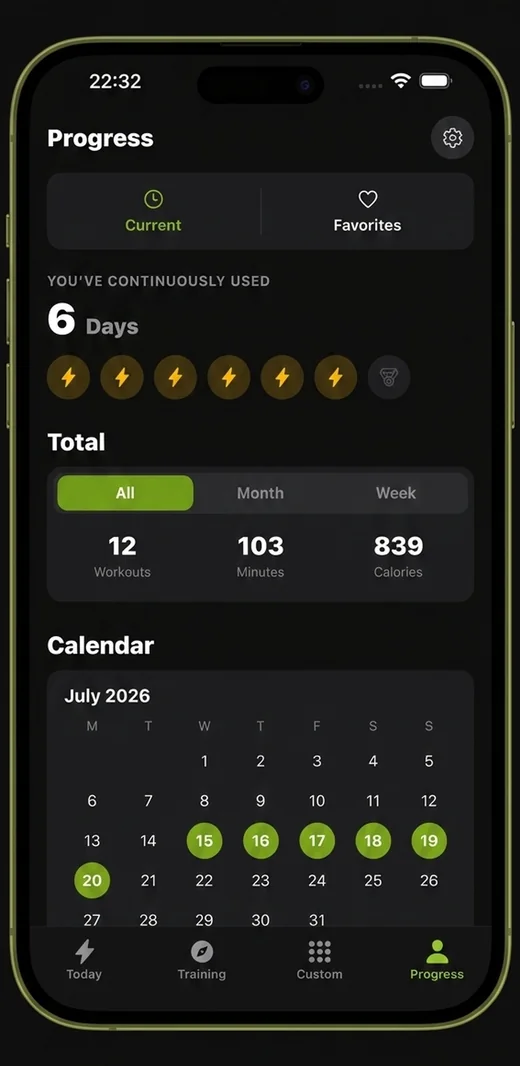
Everything on this site, built into a pocket coach. Military Calisthenics Coach turns the standards into a daily session you can run in a barracks, a garage or a hotel room — timed, tracked and scaled to you.
- A 21-day program that adapts to your level
- Guided timed sessions — no counting, no guessing
- Ranks, streaks and progress you can actually see



The upper body is where calisthenics is at its best: every pattern has a clean bodyweight version, and the progressions run from a counter push-up all the way to a one-arm pull-up without ever needing a weight. This session covers all four upper-body patterns in about 30 minutes.
The session
Two supersets and a finisher. Alternate the two movements in each pair, resting 60 seconds between them, which halves the standing around without reducing recovery for either muscle group.
| Pair | Movement | Sets × reps |
|---|---|---|
| A1 | Push-up variation | 4 × 8–12 |
| A2 | Pull-up variation | 4 × 4–8 |
| B1 | Dip variation | 3 × 6–12 |
| B2 | Australian row | 3 × 10–12 |
| C | Pike push-up | 3 × 6–10 |
| C | Hanging leg raise | 3 × 8–12 |
Warm up first: 30 seconds of arm swings, 10 scapular pulls hanging from the bar, 10 slow push-ups, 10 band or towel pull-aparts.
The ratio that matters
Count your weekly pulling sets and your weekly pressing sets. They should be roughly equal, and if anything the pulling should be higher.
Most self-taught trainees end up at two pressing sets for every pulling set, because push-ups need nothing and pull-ups are hard. The result over a couple of years is internally rotated shoulders, a rounded upper back and a joint that starts complaining during dips. The session above is deliberately balanced: two pressing movements, two pulling movements, one vertical pattern each.
If your pull-ups are far behind your push-ups, add a set to A2 and B2 for a month. The pull-up progression covers how to close the gap properly.
Choosing your variations
| Pattern | If you’re new | If it’s easy |
|---|---|---|
| Horizontal push | Counter or knee push-up | Feet elevated, archer |
| Vertical pull | Australian row, negatives | Paused, weighted |
| Vertical push | Bench dip | Ring dip, weighted dip |
| Horizontal pull | Row with bent knees | Feet elevated, one-arm assisted |
| Shoulder press | Pike push-up on the floor | Feet elevated, wall handstand |
Pick the version you can perform for eight controlled reps. If you are hitting twenty, the variation is doing nothing for you — move up, watch the number collapse, and build it back.
Why the pike push-up is in there
Overhead pressing is a pattern, and without it the shoulders get trained only from the front. A pike push-up folds you at the hips so the press runs nearly vertical, and it is the first rung of the ladder that eventually reaches a handstand push-up. Feet on a chair makes it harder; the handstand progression continues from there.
How often
Twice a week is the sweet spot when this replaces the upper-body portion of a full-body plan. Pressing and pulling muscles need roughly 48 hours, and four hard upper-body sessions a week is more than most people recover from without either a long training history or a very careful eye on sleep.
If you run this as an upper-body day, pair it with the leg workout on alternating days, or read the push/pull/legs guide for a three-way split that keeps the weekly volume in range.
Arms, specifically
There is no curl in this session and there does not need to be. Pull-ups and rows train the biceps hard through a full range; dips and push-ups do the same for the triceps. If you want more direct arm work, the cheapest additions are chin-ups (palms toward you, which shifts load onto the biceps) and diamond push-ups, one set of each at the end. Anything beyond that is decoration until the main lifts are well developed.