Push, Pull, Legs for Calisthenics
When to leave full-body training behind, and how to split bodyweight work across three days without losing the mechanism that made it work.
On iPhone

Military Calisthenics Coach
Take the drill with you
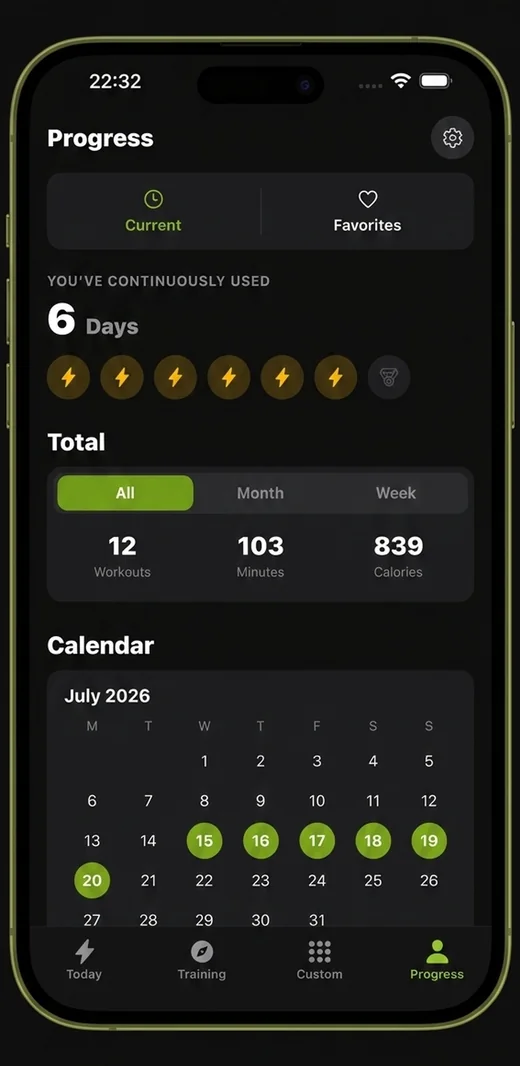
Everything on this site, built into a pocket coach. Military Calisthenics Coach turns the standards into a daily session you can run in a barracks, a garage or a hotel room — timed, tracked and scaled to you.
- A 21-day program that adapts to your level
- Guided timed sessions — no counting, no guessing
- Ranks, streaks and progress you can actually see



Full-body training three times a week is the right answer for your first year, and sometimes for your fifth. But there comes a point where you want more volume per muscle group than a 35-minute session can carry, and that is when a split starts to earn its keep. Push, pull, legs is the simplest one that works.
When to switch
Three honest signals:
- Your sessions run past 50 minutes because you keep adding movements you do not want to drop.
- You have a specific skill goal — a muscle-up, a handstand, a front lever — that needs its own practice slot while you are still fresh.
- You have been training consistently for a year or more and full-body sessions no longer produce soreness or progress.
If none of those apply, stay with the best calisthenics workout. A split adds complexity, and complexity is only worth paying for when it buys something.
The three days
Push day — chest, shoulders, triceps.
| Movement | Sets × reps |
|---|---|
| Push-up variation | 4 × 8–12 |
| Dip variation | 4 × 6–10 |
| Pike push-up | 3 × 8–10 |
| Diamond push-up | 3 × 10–15 |
Pull day — back, biceps, grip.
| Movement | Sets × reps |
|---|---|
| Pull-up variation | 4 × 5–8 |
| Australian row | 4 × 8–12 |
| Chin-up | 3 × 6–10 |
| Hanging leg raise | 3 × 10–12 |
Legs day — quads, hamstrings, glutes, calves.
| Movement | Sets × reps |
|---|---|
| Split squat variation | 4 × 10–15 each leg |
| Nordic curl negative | 3 × 5–8 |
| Single-leg hip bridge | 3 × 12 each leg |
| Single-leg calf raise | 3 × 15–20 each leg |
| Hollow hold | 3 × 30–45 sec |
Scheduling it
| Days per week | Pattern | Who it suits |
|---|---|---|
| 3 | Push / Pull / Legs, one rest day between each | Most people leaving full-body |
| 4 | Push / Pull / Legs / Upper, rotating | A specific upper-body goal |
| 6 | Push / Pull / Legs twice, one rest day | Advanced, well-recovered, well-fed |
The six-day version is where most people overreach. It doubles the training load without doubling the sleep, and the usual result is three good weeks followed by a stall. Start with three days, run it for two months, and only then consider adding.
What must not change
The split changes when you train each pattern. It must not change the two things that made the training work in the first place.
Every movement still needs a next rung. More sets is not progression, it is more of the same. Each day’s first movement should still be the hardest variation you can perform for the listed reps, and it should still move up when the top of the range gets clean. The ladders in the push-up, pull-up and dip progressions do not change just because the schedule did.
You still need a deload. Every fourth week, drop to two-thirds of the sets and hold the variations where they are. A split accumulates more fatigue than full-body training, so the deload matters more here, not less.
Where skill work goes
At the start of the relevant day, while you are fresh and before the volume work. Handstand practice at the start of push day; front lever or muscle-up work at the start of pull day. Ten to fifteen minutes, never to failure — skill practice is practice, and a tired rep teaches a bad pattern.
The handstand progression and the muscle-up progression both assume this slot.
Going back
There is no shame in returning to full-body training, and plenty of experienced athletes rotate between the two through the year: a split when time and energy are abundant, full-body when work is busy. Three good full-body sessions beat six skipped split days, every time.