Dip Progression: Bench to Ring Dips
Seven rungs to a strong, shoulder-safe dip — the heaviest pressing movement available without weights.
On iPhone

Military Calisthenics Coach
Take the drill with you
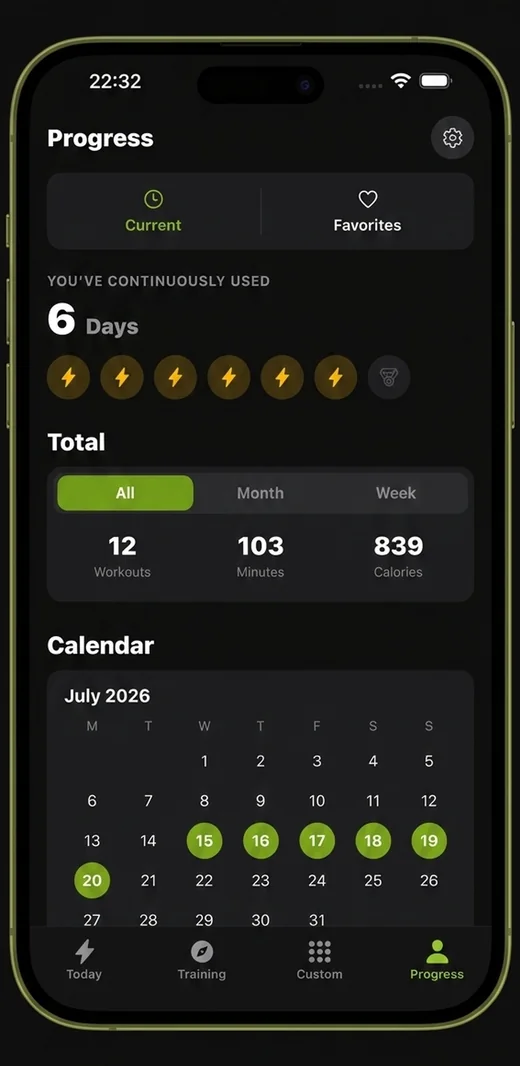
Everything on this site, built into a pocket coach. Military Calisthenics Coach turns the standards into a daily session you can run in a barracks, a garage or a hotel room — timed, tracked and scaled to you.
- A 21-day program that adapts to your level
- Guided timed sessions — no counting, no guessing
- Ranks, streaks and progress you can actually see



The dip is the heaviest press in calisthenics. In a push-up you support roughly 65% of your weight; in a dip you support all of it, which is why most people can manage twenty push-ups and three dips. It is also the movement most likely to irritate a shoulder if you rush it, so the ladder below is worth taking one rung at a time.
What a good dip looks like
- Straight arms at the top, shoulders pressed down away from your ears.
- A slight forward lean of the torso — vertical is a triceps dip, leaning is a chest dip, and the lean is easier on the shoulder.
- Lower until your upper arms are roughly level with the floor. Not deeper.
- Elbows tracking backwards, close to the body, not flaring wide.
The depth rule matters. Dropping below parallel puts the shoulder into deep extension under full bodyweight, and that is where most dip-related shoulder pain begins.
Rung 1 — Support hold
Get on the bars, lock your arms, press your shoulders down and hold. Nothing else.
This teaches the top position and builds the stability the whole movement needs. If your shoulders creep up toward your ears, you are not ready for reps.
Target: 3 × 30 seconds.
Rung 2 — Bench dip
Hands on a bench behind you, feet on the floor, knees bent. Lower until the upper arms are parallel to the ground, then press up.
Walk the feet further out to make it harder. Do not go deeper to make it harder — the shoulder position in a bench dip is already less friendly than on parallel bars, and depth is where it gets unpleasant.
Target: 3 × 15.
Rung 3 — Negative dip
Jump or step to the top of the parallel bars, then lower yourself as slowly as you can. Four to five seconds. Step back up.
Like the negative pull-up, this is the rung that does the most work.
Target: 4 × 3 with a 5-second descent.
Rung 4 — Full dip
Start at the top, lower to parallel, press back to a lockout. Your first few will feel very different from the negatives.
Target: 3 × 8.
Rung 5 — Paused dip
Two seconds held at the bottom of every rep. This kills the bounce out of the bottom position and builds strength precisely where the movement is hardest.
Target: 3 × 6 with a 2-second pause.
Rung 6 — Weighted dip
A belt, or a backpack with books in it. Start with 5 kg and add slowly. Dips take load well and this is where most of the pressing strength past the intermediate stage comes from. Timing and increments are in weighted calisthenics.
Target: 3 × 8 with 10% of bodyweight.
Rung 7 — Ring dip
Rings move, so your shoulders must stabilise in every direction at once. Start with a support hold on the rings — expect it to be humbling — then negatives, then full reps. Turning the rings out at the top is the final refinement, and it is also the position the muscle-up needs.
Target: 3 × 5 clean reps.
The ladder at a glance
| Rung | Movement | Target |
|---|---|---|
| 1 | Support hold | 3 × 30 sec |
| 2 | Bench dip | 3 × 15 |
| 3 | Negative dip | 4 × 3 (5 sec) |
| 4 | Full dip | 3 × 8 |
| 5 | Paused dip | 3 × 6 |
| 6 | Weighted dip | 3 × 8 at +10% bodyweight |
| 7 | Ring dip | 3 × 5 |
If your shoulder complains
Stop and check three things before adding any volume: are you going deeper than parallel, are your shoulders shrugging up at the top, and are you doing at least as much pulling as pressing each week? In most cases one of those three is the answer. The upper-body session is built around that last ratio for exactly this reason.
Dips sit fourth in the best calisthenics workout, after the pull-up, which means your back is already warm and engaged when you get to them. That order is deliberate.