The 4-Week Calisthenics Workout Plan
A complete four-week bodyweight programme: three sessions a week, six movements, and exactly what changes from Monday to Monday.
On iPhone

Military Calisthenics Coach
Take the drill with you
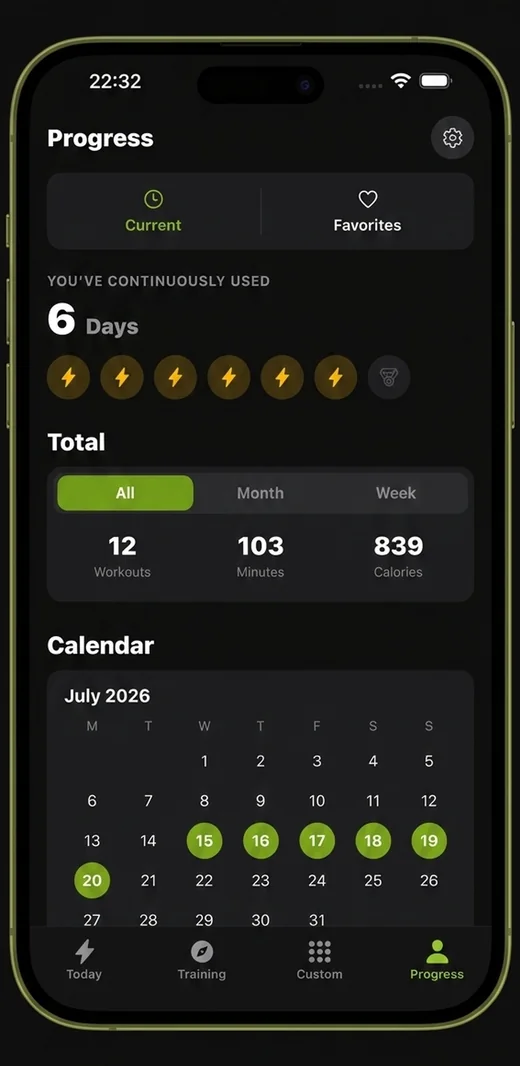
Everything on this site, built into a pocket coach. Military Calisthenics Coach turns the standards into a daily session you can run in a barracks, a garage or a hotel room — timed, tracked and scaled to you.
- A 21-day program that adapts to your level
- Guided timed sessions — no counting, no guessing
- Ranks, streaks and progress you can actually see



A plan is not a list of exercises. It is a list of exercises plus a rule for what changes next week — and the second half is the part most calisthenics routines leave out. This is the best calisthenics workout run as a four-week block, with the progression written down so you never have to guess what Monday looks like.
The structure
Three full-body sessions a week, on non-consecutive days. Monday, Wednesday and Friday is the usual choice; Tuesday, Thursday and Saturday works identically. Each session is the same six movements in the same order, and one variable changes each week.
| Week | Sessions | Volume | Tempo | Purpose |
|---|---|---|---|---|
| 1 | 3 | 3 sets | Normal | Find the right variation of each movement |
| 2 | 3 | 4 sets | Normal | Add a set, change nothing else |
| 3 | 3 | 4 sets | 3 sec down | Add time under tension, not reps |
| 4 | 2 | 3 sets | Normal | Deload, then retest |
That is the whole mechanism. Week 2 adds volume, week 3 adds tension, week 4 takes both away so the adaptation can surface. Most people who stall on bodyweight training stall because they never built week 4 into the plan.
The session
The same six movements every time, one per movement pattern.
| Order | Movement | Week 1 | Week 2 | Week 3 | Week 4 |
|---|---|---|---|---|---|
| 1 | Push-up | 3 × 8 | 4 × 10 | 4 × 10 slow | 3 × 8 |
| 2 | Pull-up | 3 × 3 | 4 × 4 | 4 × 4 slow | 3 × 3 |
| 3 | Split squat | 3 × 10 each | 3 × 12 each | 3 × 12 slow | 3 × 10 each |
| 4 | Dip | 3 × 6 | 4 × 8 | 4 × 8 slow | 3 × 6 |
| 5 | Nordic negative | 3 × 5 | 3 × 6 | 3 × 6 slow | 3 × 5 |
| 6 | Hollow hold | 3 × 20 sec | 3 × 30 sec | 3 × 30 sec | 3 × 20 sec |
Rest 60 to 90 seconds between sets. “Slow” means a three-second lowering phase on every rep — the lift up stays normal speed.
Warm up first: two minutes of skipping or brisk marching, ten arm circles each direction, ten scapular pulls hanging from the bar, ten bodyweight squats and ten slow push-ups. Five minutes, no more.
Picking your starting variation
The rep numbers above assume you have chosen a version of each movement you can perform for about eight controlled reps. If you can do thirty, the version is too easy and week 3 will do nothing. If you can do three, you will fail sets all month.
| Movement | Too hard? Use this | Too easy? Use this |
|---|---|---|
| Push-up | Hands on a counter or bench | Feet elevated, then archer |
| Pull-up | Australian rows, or 5-sec negatives | Pause at the top, then add weight |
| Split squat | Two-leg squat to a chair | Rear foot elevated, then pistol to a box |
| Dip | Bench dips, feet on the floor | Pause at the bottom, then weight |
| Nordic negative | Single-leg hip bridges | Slow past 5 seconds, then pull back up |
| Hollow hold | Knees tucked | Arms overhead, then hollow rocks |
The push-up progression and pull-up progression guides lay out every rung in detail if you are not sure where you land.
The log
Write down every set. Not a training journal with feelings in it — six lines with numbers:
Wed 12 Aug
Push-up (feet on floor)   10 / 10 / 9 / 8
Pull-up (negatives 5s)     4 /  4 / 3 / 3
Split squat               12 / 12 / 11
Dip (bench)                8 /  8 / 7 / 6
Nordic negative            6 /  5 / 5
Hollow hold (tucked)      30 / 30 / 25
Next session, beat one line. That is the entire theory of progressive overload, and a written record is the only way to know whether you managed it. Memory is generous about last week’s numbers in a way that stalls progress for months.
Week 5 and beyond
At the end of week 4, take a rest day, then test one maximum set of push-ups, pull-ups and the hollow hold. Those three numbers are your new baseline.
Then run the block again. For any movement where you passed the top of the rep range with a clean tempo, move up a variation and start it back at the bottom of the range — that reset is not a step backwards, it is the whole point. A person doing 4 × 10 feet-elevated push-ups is far stronger than the same person doing 4 × 25 on the floor, even though the number went down.
Two or three blocks in, when the six movements stop covering everything you want to train, split the work across more days. The push/pull/legs guide covers how to make that change without losing the mechanism that got you here.
What to eat and how to sleep
Neither is the topic of this page, but both decide whether the plan works. Protein at roughly 1.6 grams per kilogram of bodyweight per day supports the repair the training demands, and seven to nine hours of sleep does more for strength than any extra set you could add. Training three times a week and sleeping five hours a night is a plan that cancels itself out.