Push-Up Progression: Counter to One-Arm
Eight rungs from a push-up against a kitchen counter to a one-arm push-up, with the rep target that tells you when to move up.
On iPhone

Military Calisthenics Coach
Take the drill with you
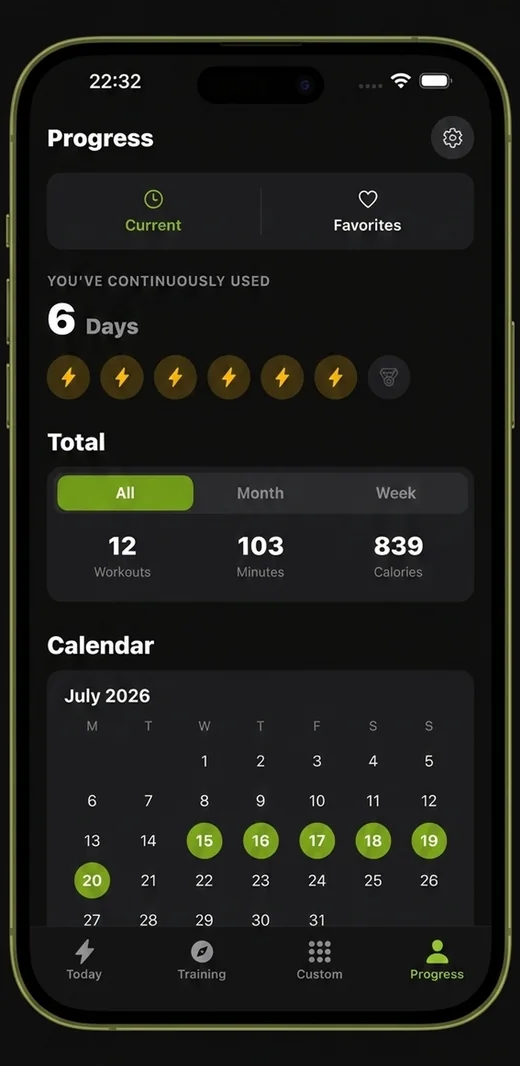
Military Calisthenics Coach is a 21-day military-style calisthenics program for iPhone: one guided bodyweight workout a day, with timed sets and rests, ranks and streaks. It is a separate program from the guides on this site.
- A 21-day military-style program, one workout a day
- Guided timed sessions — no counting, no guessing
- Build your own sessions by time, body zone or focus



A push-up is not one exercise. It is a dial: the higher your hands, the lighter the rep, and the narrower your base of support, the heavier it gets. Understand that and you never need a gym for pressing strength again — you simply move along the dial. Here is the whole thing, in order.
The rule for moving up
Move to the next rung when you can perform three sets of twelve clean reps with a two-second lowering phase on the current one. Not twelve sloppy reps — twelve that look identical to each other, with the hips in line and the elbows tracking back rather than flaring out to the sides.
When you move up, your rep count will fall off a cliff. That is what progress looks like in calisthenics.
Rung 1 — Counter push-up
Hands on a kitchen counter or a waist-high railing, feet back far enough that your body makes one straight line. Lower the chest to the surface, press away.
The higher the hands, the easier the rep, so this rung is really a whole set of rungs: counter, then a table, then a chair, then a step. Work down the heights one at a time and the floor arrives on its own.
Target: 3 × 12.
Rung 2 — Knee push-up
On the floor, knees down, hips extended so the line runs from knee to head without a sag. Most people do these with a folded waist, which turns the hardest part of the movement off. Squeeze the glutes.
Target: 3 × 12.
Rung 3 — Full push-up
Hands under the shoulders, slightly wider than the ribcage. Elbows back at about 45 degrees, not out at 90. Chest to within a fist of the floor, then press away hard enough that your shoulder blades spread apart at the top — that last inch trains the serratus, and skipping it is how people end up with cranky shoulders years later.
Target: 3 × 12, then keep going to 3 × 20 before you move on. The full push-up is worth over-developing; everything above it is built on it.
Rung 4 — Tempo push-up
Same movement, three seconds down, one-second pause at the bottom, normal speed up. Tempo is the cheapest form of overload in calisthenics: the load is identical and the demand is much higher.
Target: 3 × 10 at a 3-1-1 tempo.
Rung 5 — Feet-elevated push-up
Feet on a chair or bench. Raising the feet shifts your weight forward onto the hands and moves the emphasis toward the upper chest and shoulders. Go one height at a time — a 30 cm step, then a chair, then a bench.
Target: 3 × 12 with the feet on a chair.
Rung 6 — Archer push-up
Wide hand position. Lower toward one hand while the other arm straightens out to the side, taking maybe a quarter of the load. Alternate sides each rep or each set.
This is the first rung where one arm is doing most of the work, and it is where one-arm strength actually gets built.
Target: 3 × 8 per side.
Rung 7 — Uneven / lever push-up
Both hands on the floor, but one hand rests on a ball, a block or a low step so the working arm carries far more of the load. Lower the block over successive weeks.
Target: 3 × 6 per side with the hand on a low block.
Rung 8 — One-arm push-up
Feet wide for balance, working hand under the shoulder, free arm behind the back. Keep the hips as square to the floor as you can — some rotation is inevitable, a full twist means the rung is still too hard.
Target: one clean rep per side. Then three. Then five.
The whole ladder at a glance
| Rung | Movement | Target before moving up |
|---|---|---|
| 1 | Counter push-up | 3 × 12 |
| 2 | Knee push-up | 3 × 12 |
| 3 | Full push-up | 3 × 20 |
| 4 | Tempo push-up (3-1-1) | 3 × 10 |
| 5 | Feet-elevated push-up | 3 × 12 |
| 6 | Archer push-up | 3 × 8 per side |
| 7 | Uneven push-up | 3 × 6 per side |
| 8 | One-arm push-up | 1 clean rep |
How often to train them
Twice or three times a week, inside a full-body session — not every day. The push-up is a pressing movement for the chest, shoulders and triceps, and those tissues need the same 48 hours anything else does. Daily push-up challenges produce a quick two-week jump and then a plateau with sore elbows, which is a bad trade.
Slot it in as the first movement of the best calisthenics workout, and pair it with the pull-up progression so your pulling strength keeps up with your pressing. That balance matters more than either number on its own: shoulders stay healthy when the back is at least as strong as the chest.