Calisthenics Equipment Worth Buying
One essential purchase, three useful ones, and the gear that solves problems you do not have.
On iPhone

Military Calisthenics Coach
Take the drill with you
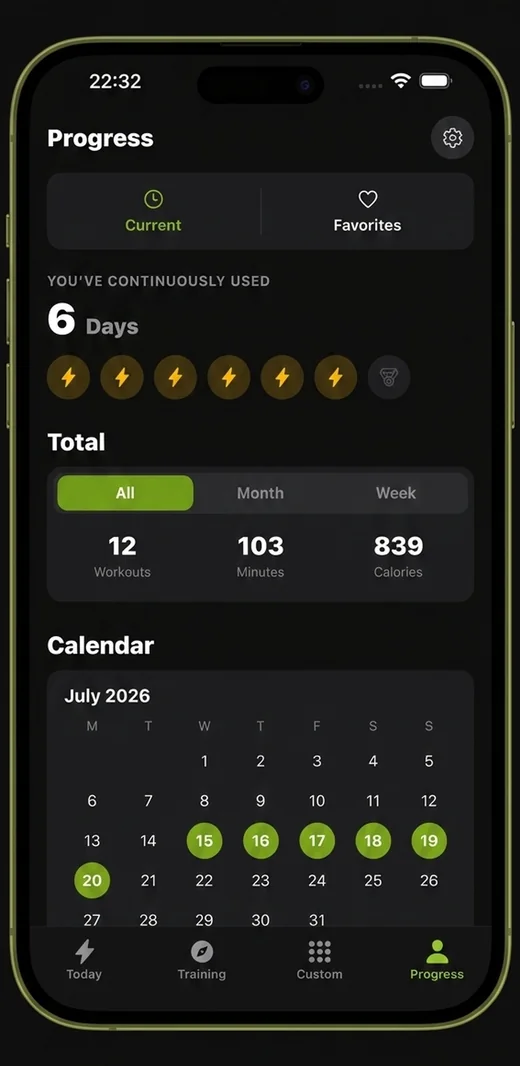
Everything on this site, built into a pocket coach. Military Calisthenics Coach turns the standards into a daily session you can run in a barracks, a garage or a hotel room — timed, tracked and scaled to you.
- A 21-day program that adapts to your level
- Guided timed sessions — no counting, no guessing
- Ranks, streaks and progress you can actually see



Calisthenics has a marketing problem: a method whose entire appeal is that it needs nothing has an industry selling things to do it with. Here is the short list that earns its shelf space, in the order worth buying it.
Buy first: a pull-up bar
The only genuinely essential item, because the vertical pull is the one movement pattern with no floor-based substitute. Everything else in the best calisthenics workout can be done with a floor and a table.
Three formats:
- Doorway bar (tension-mounted). Cheap, no tools, removable. Check the door frame is solid and the bar is rated well above your weight. Most have a hard ceiling around 100 kg.
- Doorway bar (screwed in). Far more secure, leaves four holes in the frame. Worth it if you own the place.
- Wall or ceiling mount. The best option if you have a solid wall and are staying put. Gives full range with no head-knocking.
If none of these are possible, a local park almost certainly has a bar, and outdoor training is pleasant more often than people expect.
Buy second: parallettes
A pair of low parallel bars, either bought or made from plumbing pipe for the price of a coffee. They unlock dips, L-sits, and the wrist-friendly version of push-ups, and they are the entry point to the entire handstand progression.
Low parallettes (15–20 cm) are more useful than tall ones for most people.
Buy third: gymnastic rings
The most versatile piece of equipment in the sport, and the one that keeps paying off for years. Rings let you row at any angle, dip with a free path for the shoulders, and perform every pull-up variation with a rotating grip that is noticeably kinder to the elbows.
They also make everything harder, because the rings move. A ring push-up is a substantially different exercise from a floor push-up at the same body angle.
Hang them from a bar, a beam or a tree branch. Adjustable straps are standard.
Buy fourth, and only later: a weight belt
Once you can do ten strict pull-ups and fifteen dips, bodyweight progressions on those two movements get coarse, and hanging weight from a belt is the clean solution. Until then it is a solution to a problem you do not have. See weighted calisthenics for the timing.
A loaded backpack does the same job for less money and is more awkward on pull-ups. Both work.
What the list looks like
| Item | Cost | Unlocks | Buy it when |
|---|---|---|---|
| Pull-up bar | Low | Vertical pull, hanging core work | Now |
| Parallettes | Low | Dips, L-sit, handstand work | Month 2–3 |
| Rings | Medium | Rows, ring dips, everything else | Month 6+ |
| Weight belt | Low | Loaded pull-ups and dips | 10 pull-ups, 15 dips |
What you can skip
Resistance bands for pull-ups. They assist most at the bottom, where the movement is hardest, so you train the range you already own. Rows and negatives build the missing strength instead — the reasoning is in the pull-up progression.
Push-up handles. They add a small amount of range and take pressure off the wrists. Parallettes do both better and do more besides.
Ab wheels, suspension trainers, weighted vests, grip trainers. All fine products; none of them solve a problem in a bodyweight programme that the four items above do not already solve.
Anything described as a “complete home gym system”. If it folds, it is usually flimsy, and the movements it enables are movements a bar and a floor already enable.
A note on flooring and clothing
An exercise mat is worth having if your floor is hard — not for safety, for the willingness to actually get down on it. And shoes matter for legs: split squats and pistols are easier to learn barefoot or in flat-soled shoes than in running trainers with a soft, high heel.