The Five-Minute Calisthenics Warm-Up
What a warm-up is actually for, the five minutes that do it, and why static stretching before training makes you weaker.
On iPhone

Military Calisthenics Coach
Take the drill with you
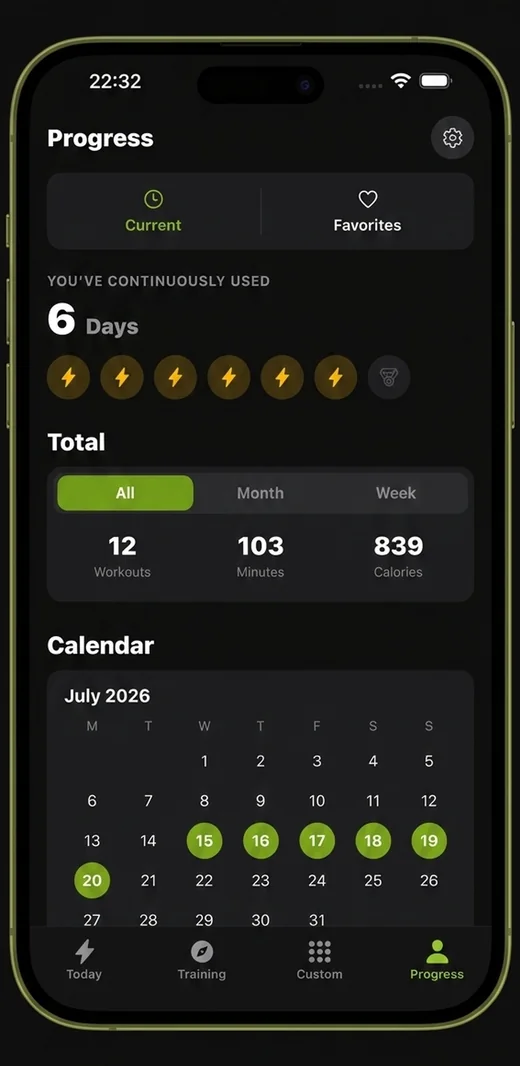
Everything on this site, built into a pocket coach. Military Calisthenics Coach turns the standards into a daily session you can run in a barracks, a garage or a hotel room — timed, tracked and scaled to you.
- A 21-day program that adapts to your level
- Guided timed sessions — no counting, no guessing
- Ranks, streaks and progress you can actually see



A warm-up has one job: make the next 30 minutes safer and better. It is not a workout, it is not a stretching session, and it does not need to take fifteen minutes. Five is enough, and the five below are the ones worth spending.
What it is for
Three things, in order of importance.
- Raise tissue temperature. Warm muscle is more compliant and produces force more readily. This is most of the benefit and it takes about two minutes of general movement.
- Take the joints through the range you are about to load. Shoulders overhead, hips into a deep squat, spine into flexion and extension.
- Rehearse the movements. Light sets of what you are about to do hard.
Notice what is absent: nothing on that list requires holding a hamstring stretch for thirty seconds.
The five minutes
| Minute | What | Reps |
|---|---|---|
| 0:00–2:00 | Skipping, brisk marching or easy jogging | Continuous |
| 2:00–2:40 | Arm circles, forward then backward | 10 each way |
| 2:40–3:20 | Deep squat hold, rocking side to side | 40 sec |
| 3:20–4:00 | Scapular pulls hanging from the bar | 8 slow |
| 4:00–4:30 | Bodyweight squats | 10 |
| 4:30–5:00 | Slow push-ups | 10 |
That is it. If you are training legs hard, add ten walking lunges. If you are going overhead — pike push-ups, handstands — add the wrist work from the handstand progression.
Why not static stretching first
Holding a stretch for 30 seconds or more before training measurably reduces force production for a period afterwards. The effect is not enormous and it is not permanent, but it is real, and there is no reason to accept a small strength penalty at the start of a strength session.
Static stretching is genuinely useful — it just belongs afterwards, or on a rest day, when the goal is range of motion rather than performance in the next ten minutes.
The warm-up set
The most useful thing in the list above is the last two lines: light sets of the movements you are about to train. Before a hard set of pull-ups, do three easy ones. Before weighted dips, do a set at bodyweight.
This does two things at once. It finishes preparing the exact tissues under the exact load pattern, and it tells you how today is going. A warm-up set that feels heavier than usual is information — often the most reliable sign that you are under-recovered, which the recovery guide covers in more detail.
Cooling down
Optional, and less important than the internet suggests. There is little evidence that a cool-down reduces next-day soreness. What it does do is provide a convenient slot for the mobility work that actually matters, while you are warm and already on the floor.
Two minutes is enough: a deep squat hold, a couch stretch for the hip flexors, and a doorway chest stretch. Every session, and your hips and shoulders will thank you in a decade.
One caveat for cold mornings
If you train early or somewhere cold, extend the first block to four minutes rather than two. Tissue temperature is the whole mechanism, and a body that has been asleep for eight hours in a cold room needs longer to reach it than the protocol assumes. The rest of the workout does not change.