How Much Rest Calisthenics Actually Needs
Rest between sets, between sessions and between blocks — the three timescales that decide whether training turns into strength.
On iPhone

Military Calisthenics Coach
Take the drill with you
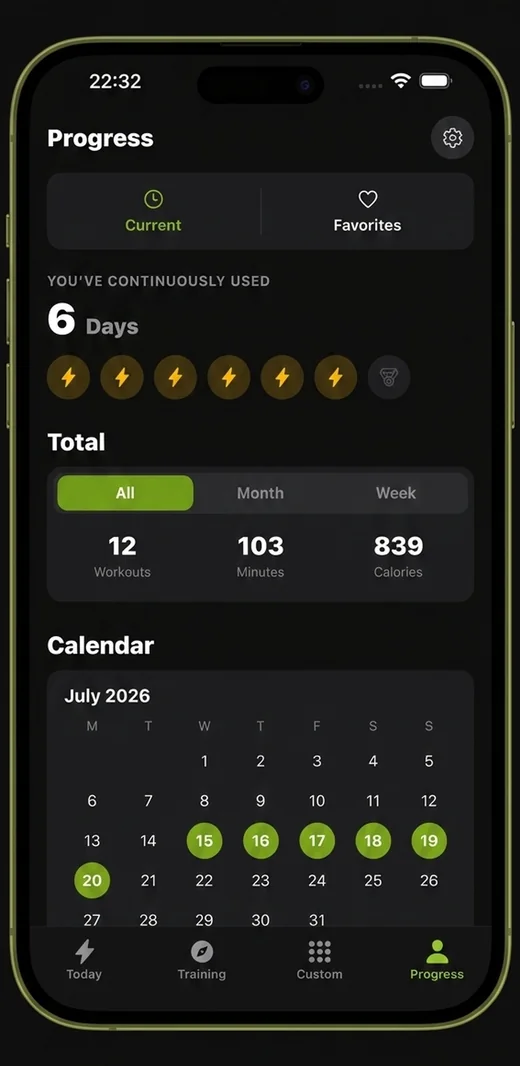
Everything on this site, built into a pocket coach. Military Calisthenics Coach turns the standards into a daily session you can run in a barracks, a garage or a hotel room — timed, tracked and scaled to you.
- A 21-day program that adapts to your level
- Guided timed sessions — no counting, no guessing
- Ranks, streaks and progress you can actually see



Training is a stimulus. Strength is the response, and the response happens while you are not training. That makes rest a programming variable with numbers attached, not a vague virtue — and there are three separate timescales worth getting right.
Rest between sets: 60 to 90 seconds
This is the one people get wrong most often, usually by resting far too little.
A set taken near failure depletes the muscle’s immediate energy supply, and it takes a couple of minutes to restore. Rest 30 seconds and your next set is limited by fatigue rather than by strength, so you train endurance while believing you are training strength. Rest 90 seconds and you can actually repeat the effort.
| Type of set | Rest |
|---|---|
| 8–15 reps, moderate difficulty | 60–90 sec |
| 3–6 reps, hard variation | 2–3 min |
| Weighted work or maximal attempts | 3–5 min |
| Skill practice (handstands, levers) | As long as you want |
| Supersets, opposing patterns | 60 sec between movements |
Pairing a push with a pull — as the upper-body session does — lets you cut total session time without cutting recovery for either muscle, because the back rests while the chest works.
Rest between sessions: 48 hours
Muscle protein synthesis stays elevated for roughly 24 to 48 hours after a hard session. Training the same pattern again before that window closes interrupts the process rather than adding to it.
In practice: hard sets for a given muscle group two, at most three, times a week. Full-body training on Monday, Wednesday and Friday does this automatically, which is a large part of why the best calisthenics workout is scheduled that way.
Daily push-up challenges are the classic counter-example. They work for two or three weeks — mostly through skill learning — and then stall, usually with an elbow that has started to talk.
Rest between blocks: one week in four
The least intuitive and the most valuable. Every fourth week, cut your sets by about a third and hold your variations where they are. Do not add anything.
Fatigue accumulates faster than you notice, and it masks the strength you have built. A deload week lets it clear, and most people test higher numbers in week five than they could manage in week four. The 4-week plan has this built in for exactly that reason.
What a rest day should contain
Not nothing. Movement on a rest day speeds recovery rather than hindering it.
- A 20 to 40 minute walk.
- Five to ten minutes of mobility work on whatever is tight — usually ankles, hips and the thoracic spine for people who train bodyweight.
- Easy skill practice if you are working on one: a few wall handstand holds, a dead hang, nothing near failure.
What it should not contain is another hard session under a different name. Two hundred push-ups “because it is only bodyweight” is a training session.
Sleep is the actual recovery
Seven to nine hours. Growth hormone release, protein synthesis and nervous system recovery all concentrate in sleep, and no supplement, protocol or stretching routine substitutes for it. If you are training three times a week and sleeping five hours a night, the sleep is the limiting factor and nothing on this site will fix it.
Signs you are under-recovered
- Reps falling across two consecutive sessions on movements that were improving.
- Resting heart rate noticeably higher than usual on waking.
- Joints, not muscles, aching — particularly elbows and the front of the shoulder.
- Enthusiasm for training quietly disappearing.
Any two of these together mean take a week at two-thirds volume. This is almost never the wrong call, and the week you lose is always shorter than the six weeks an injury costs.