Does Calisthenics Build Muscle?
Yes — and the mechanism is the same one weights use. What matters is whether your training supplies it, which most bodyweight routines do not.
On iPhone

Military Calisthenics Coach
Take the drill with you
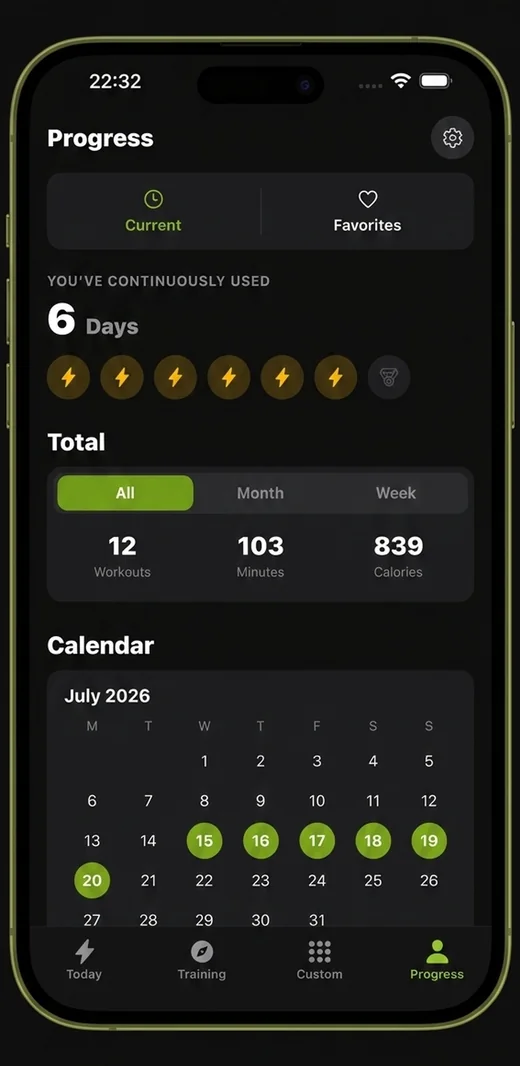
Everything on this site, built into a pocket coach. Military Calisthenics Coach turns the standards into a daily session you can run in a barracks, a garage or a hotel room — timed, tracked and scaled to you.
- A 21-day program that adapts to your level
- Guided timed sessions — no counting, no guessing
- Ranks, streaks and progress you can actually see



Muscle grows in response to mechanical tension, applied repeatedly, with enough food and rest to rebuild afterwards. That is the whole mechanism. Nothing in it specifies where the tension comes from, which is why the honest answer to the question is: yes, obviously — provided your training actually supplies tension that increases over time.
Most bodyweight routines do not. That, rather than anything about barbells, is why some people train calisthenics for two years and look exactly the same.
What the research says
Studies comparing bodyweight training with free weights at matched effort generally find similar gains in upper-body muscle size. Push-up training and bench-press training have been compared directly with comparable results when sets were taken close to failure. The distinguishing variable in every one of those studies is effort, not equipment.
Where the picture changes is the lower body. A barbell can be loaded with 150 kg; your body weighs what it weighs. Two-leg squats stop being a growth stimulus somewhere around rep forty, at which point you are doing cardio with your quads. The answer is not more reps but fewer limbs — split squats, then pistols, then Nordic curls — which is why the leg workout looks so different from a leg day in a gym.
The three things that decide it
1. Does the movement get harder? A push-up you can do forty times is not a growth stimulus. Elevate the feet, slow the descent, narrow the base, remove an arm. Every entry in the push-up progression exists to solve exactly this problem.
2. Do your sets approach failure? Muscle responds to sets finished within roughly one to three reps of failure. A set of twelve with five reps left in the tank does very little. This is the most common error in bodyweight training, because bodyweight sets feel productive long after they have stopped being hard.
3. Are you eating and sleeping? Tissue is built from protein and rebuilt during sleep. Around 1.6 grams of protein per kilogram of bodyweight per day, and seven to nine hours of sleep, are the numbers most commonly cited. A perfect programme on five hours of sleep and 60 grams of protein will underperform a mediocre one done properly rested.
What “enough volume” looks like
| Muscle group | Weekly hard sets | Where it comes from |
|---|---|---|
| Chest, shoulders, triceps | 10–20 | Push-ups, dips, pike push-ups |
| Back, biceps | 10–20 | Pull-ups, rows |
| Quads, glutes | 8–16 | Split squats, pistols |
| Hamstrings | 6–12 | Nordic curls, hip bridges |
| Core | 6–12 | Hollow holds, leg raises |
Three full-body sessions a week with four sets of each movement lands squarely inside those ranges — that is the arithmetic behind the best calisthenics workout and the reason it is three sessions rather than six.
What calisthenics is worse at
Two honest limitations.
Isolating a lagging muscle. If your biceps are behind, a barbell curl solves that directly. Bodyweight alternatives exist — chin-ups, ring curls — but they are blunter instruments.
Adding load precisely. A weight stack goes up by 2.5 kg. A bodyweight progression goes up by whatever the next variation happens to cost, which is sometimes a large and awkward jump. Past the intermediate stage, most people solve this by hanging a weight from a belt, which is where weighted calisthenics comes in — and at that point the distinction between the two methods has largely dissolved anyway.
What it is better at
Joint-friendly loading, since the body chooses its own path rather than following a bar. Relative strength, which is what makes the advanced skills possible. And the fact that it happens wherever you are, which over a decade beats any amount of theoretical superiority in a gym you stop driving to.
The longer comparison is in calisthenics vs weights. The short version: the method matters far less than whether you are still doing it in three years.