The 12 Best Calisthenics Exercises
Twelve bodyweight movements that cover everything, grouped by the pattern they train — and what each one is actually for.
On iPhone

Military Calisthenics Coach
Take the drill with you
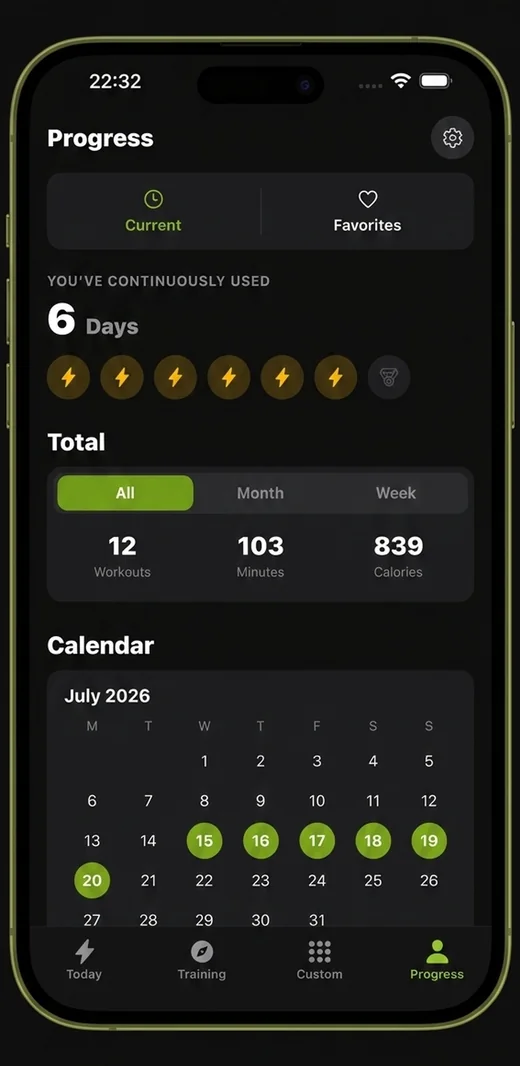
Everything on this site, built into a pocket coach. Military Calisthenics Coach turns the standards into a daily session you can run in a barracks, a garage or a hotel room — timed, tracked and scaled to you.
- A 21-day program that adapts to your level
- Guided timed sessions — no counting, no guessing
- Ranks, streaks and progress you can actually see



There are hundreds of bodyweight exercises and roughly six things a body does. That ratio is why exercise lists are usually useless: nine of every ten movements on them are variations of the other one. These twelve are the ones worth knowing, organised by the pattern they train, with a note on what each one is genuinely good for.
Horizontal push
1. Push-up. The most useful upper-body exercise that exists, because the difficulty is infinitely adjustable by angle alone. Trains chest, front shoulders, triceps and — if you hold the plank properly — the entire anterior core. See the push-up progression for the full ladder from counter to one-arm.
2. Archer push-up. A push-up with one arm straight out to the side, so the bent arm takes most of the load. The cheapest way to build toward one-arm strength without needing a single piece of equipment.
Vertical pull
3. Pull-up. Nothing else trains a vertical pull, which is why a bar is the only equipment worth buying. Builds the lats, the mid-back, the biceps and a grip that holds up under everything else. Start at the pull-up progression.
4. Australian row. A pull-up rotated 90 degrees, performed under a low bar with the heels on the floor. It is the most underrated movement in calisthenics: scalable to any strength level, kind to the shoulders, and the fastest route to a first pull-up.
Vertical push
5. Dip. The heaviest pressing movement available without weights — most people can push-up long before they can dip. Trains the lower chest, the triceps and the shoulder’s ability to stabilise under load. Progress it through the dip progression.
6. Pike push-up. A push-up folded at the hips so the press becomes nearly vertical. This is the shoulder-press substitute in a bodyweight programme and the first rung on the road to a handstand push-up.
Knee-dominant leg
7. Split squat. One leg at a time, back knee dropping toward the floor. It loads a single leg with most of your bodyweight, which is what makes it useful where two-leg squats stop being challenging around rep forty.
8. Pistol squat. A full squat on one leg with the other extended forward. Equal parts strength, balance and ankle mobility, and a genuine benchmark: most people who can do five per side have legs that need no apology.
Hip hinge
9. Nordic curl. Kneel, anchor the heels, and lower the torso toward the floor under hamstring control. Brutally hard, remarkably effective, and the only common bodyweight movement that trains the hamstrings in their lengthened position. Start with the slow lowering half only.
10. Single-leg hip bridge. Foot planted, hips driven up, one leg doing the work. The easier hinge option and the best glute movement available with no equipment at all. Most calisthenics programmes skip the hinge entirely — see the leg workout for why that is a mistake.
Core
11. Hollow hold. Lie on your back, flatten the lower back into the floor, lift the shoulders and legs. It looks like nothing and it is the position underneath every advanced skill in the sport — the front lever, the planche and the handstand are all a hollow hold at a different angle.
12. Hanging leg raise. Hang from the bar and lift straight legs to the bar without swinging. Trains the abdominals through a long range while the grip and shoulders work isometrically. Bend the knees to make it easier; add a pause at the top to make it harder. The core workout puts both to use.
How they fit together
| Pattern | Primary | Easier | Harder |
|---|---|---|---|
| Horizontal push | Push-up | Counter push-up | Archer, one-arm |
| Vertical pull | Pull-up | Australian row | Weighted, one-arm |
| Vertical push | Dip | Bench dip | Ring dip, handstand push-up |
| Knee-dominant | Split squat | Chair squat | Pistol squat |
| Hip hinge | Nordic curl | Single-leg bridge | Full Nordic curl |
| Core | Hollow hold | Tucked hollow | Hanging leg raise |
One movement per row, three or four sets each, three times a week is a complete programme — that is precisely the best calisthenics workout, and the reason it needs only six exercises rather than twelve. The other six exist so that you have somewhere to go when the first six get easy.
What is deliberately missing
No crunches: they train a short range of the same muscle the hollow hold trains better. No burpees: excellent conditioning, poor strength training, and not a substitute for either. No jumping variations for beginners — plyometrics are a sharpening tool for people who already have a base, not a way to build one.