Calisthenics for Beginners: The First 30 Days
What to do in your first month of bodyweight training, what to ignore, and the four checkpoints that tell you it is working.
On iPhone

Military Calisthenics Coach
Take the drill with you
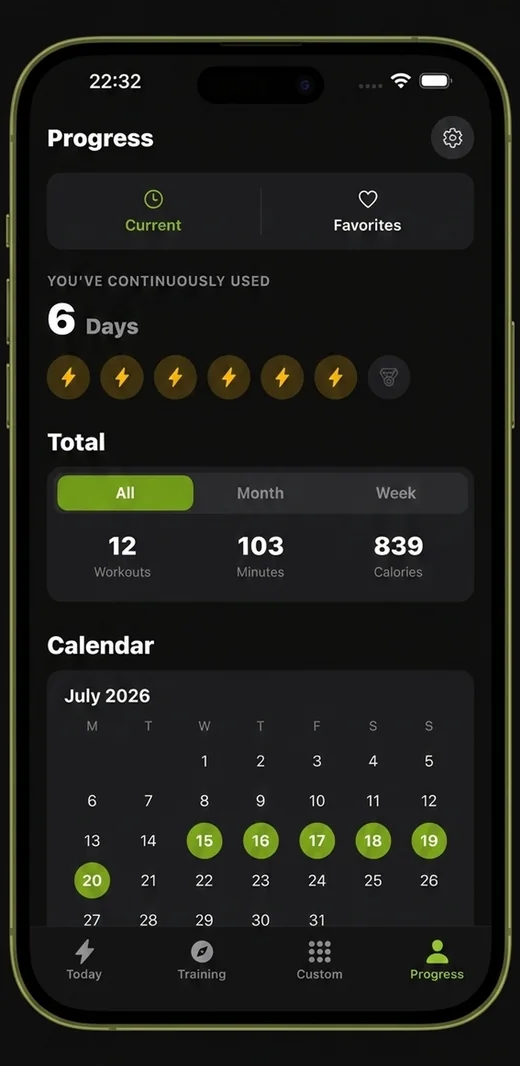
Military Calisthenics Coach is a 21-day military-style calisthenics program for iPhone: one guided bodyweight workout a day, with timed sets and rests, ranks and streaks. It is a separate program from the guides on this site.
- A 21-day military-style program, one workout a day
- Guided timed sessions — no counting, no guessing
- Build your own sessions by time, body zone or focus



The first month of calisthenics is mostly a question of not sabotaging yourself. The training is simple, the internet is not, and almost every beginner’s problem is doing too much of the wrong thing rather than too little of the right one. Here is what the first thirty days should actually contain.
Pick the version, not the exercise
The most common beginner mistake is treating “push-up” as a pass/fail test. It is not an exercise, it is a family of them, and your job in week one is to find the member of the family you can do for eight clean reps.
| If you can’t do a… | Do this instead |
|---|---|
| Push-up | Push-up with hands on a kitchen counter |
| Pull-up | Australian row under a low bar or table |
| Dip | Bench dip with your feet on the floor |
| Squat | Sit-to-stand from a chair |
| Hollow hold | Same hold with the knees tucked to the chest |
Every one of those is real training, not a consolation prize. Strength built on a counter transfers directly to the floor, because it is the same movement at a lighter angle. The push-up progression explains the whole ladder.
Three sessions, not seven
Train Monday, Wednesday and Friday. Rest — or walk — on the days in between.
Strength is not built during the workout; it is built while you repair from it. Beginners who train every day get the stimulus without the repair, and the usual result is sore elbows by week three and a quiet retirement by week five.
Your first month, in full:
| Week | Sessions | What you are doing |
|---|---|---|
| 1 | 3 | Finding the right variation of each movement, 2 sets each |
| 2 | 3 | Same variations, 3 sets each |
| 3 | 3 | Same variations, 3 sets, one extra rep per set |
| 4 | 3 | Add a fourth set to the push and the pull only |
The session itself is the best calisthenics workout — six movements, one per pattern, about 35 minutes including the warm-up.
Learn what the positions feel like
More than half of what you gain in month one is skill. A push-up done with a sagging hip and flared elbows trains a different thing from a push-up done in a straight line, and the difference shows up years later as a shoulder that does not like being loaded overhead.
Three cues worth more than any amount of extra volume:
- Squeeze the glutes in every pushing movement. It stops the lower back from arching and turns the whole body into one rigid plank.
- Pull your shoulders down away from your ears before you pull. On the bar and on the floor. If the shoulders shrug up first, the arms do work the back should be doing.
- Own the lowering. Two seconds down on every rep. The lowering phase builds more strength than the lifting phase and it is the half everybody rushes.
Four checkpoints
At the end of the month, these tell you whether it worked:
- Reps went up on at least four of the six movements. Not all six — some weeks one movement stalls, which is normal.
- You can hold a hollow position for 30 seconds without your back lifting off the floor. Core endurance is the quietest predictor of how the harder skills will go later.
- You have trained twelve times. Three a week, four weeks. Consistency is the variable that outperforms every other choice on this page.
- Nothing hurts in a sharp or one-sided way. Muscle soreness a day after training is fine and normal. Joint pain is information, not toughness.
What to ignore in month one
Skill work, mostly. Handstands, levers, muscle-ups and planches are wonderful and they will still be there in a year — but training them before you own twenty push-ups and a strict pull-up spends your limited recovery on the wrong thing. The muscle-up progression is worth reading; it is not worth attempting yet.
Also ignore: anything that promises a result in a fixed number of days, any programme with more than eight exercises, and any argument about calisthenics versus weights. Pick one, do it for a year, and then hold an opinion.
What comes after thirty days
Run the 4-week calisthenics workout plan, which adds the tempo and deload structure your first month deliberately left out. By then you will know your variations, your rep ranges and roughly how your body responds — which is exactly the information a real programme needs.