01 Beginner
The 4-Week Calisthenics Workout Plan
A complete four-week bodyweight programme: three sessions a week, six movements, and exactly what changes from Monday to Monday.
Free · One pull-up bar · 35 minutes
Six movements, one per pattern your body owns, three times a week. Every movement states the number that earns you the next rung — so you never have to wonder whether you have outgrown a variation.
Most calisthenics workouts are a pile of movements with nothing attached that says when to change them. The movements are the easy part — push, pull, squat, brace, dip. What separates a programme from a workout you found this morning is the progression rule bolted to it.
That rule is what this page is built around. Six movements cover every pattern once, each one names the variation above and below it, and one number decides when you move. Everything else is turning up.
On iPhone

Military Calisthenics Coach
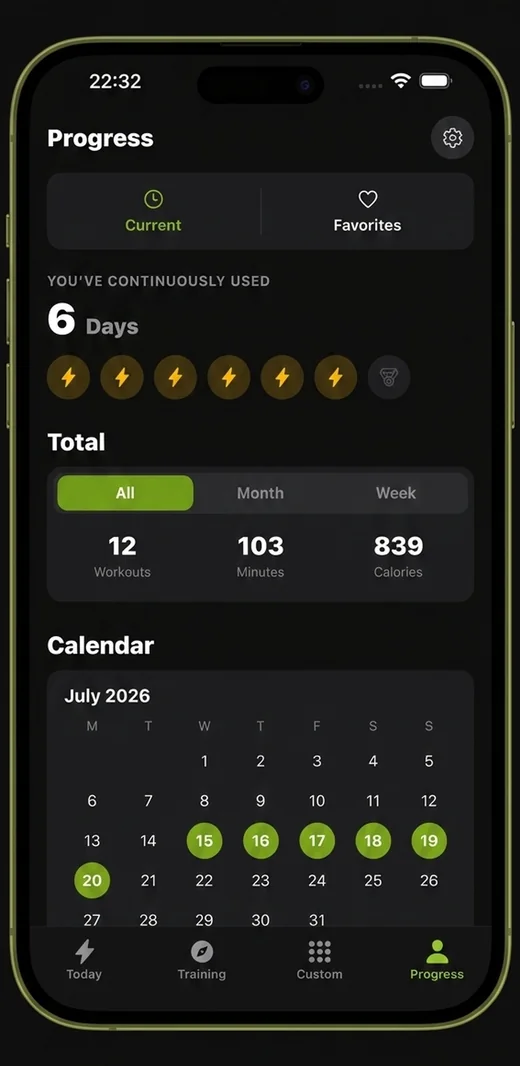
Everything on this site, built into a pocket coach. Military Calisthenics Coach turns the standards into a daily session you can run in a barracks, a garage or a hotel room — timed, tracked and scaled to you.



01 / The session
Work through them in this order. Rest 60 to 90 seconds between sets, and pick the version of each movement you can perform for eight controlled reps — no more, no less.
| No. | Movement | Pattern | Sets × reps |
|---|---|---|---|
| 01 | Push-up | Horizontal push | 4 × 8–15 |
| 02 | Pull-up | Vertical pull | 4 × 3–8 |
| 03 | Split squat | Knee-dominant leg | 3 × 10–15 each leg |
| 04 | Dip | Vertical push | 3 × 6–12 |
| 05 | Nordic curl negative | Hip hinge | 3 × 5–8 |
| 06 | Hollow hold | Anti-extension core | 3 × 30 sec |
Warm up five minutes first · Rest 60–90 s between sets
4 × 8–15
Hands under the shoulders, elbows tracking back at about 45°, body in one line from heel to head. Lower until your chest is a fist off the floor, then press away hard enough that your shoulder blades spread at the top.
4 × 3–8
Hang with straight arms and the shoulders pulled down away from your ears. Lead with the elbows, clear the bar with your chin, then lower all the way back to a dead hang. No kick, no kip.
3 × 10–15 each leg
Long stance, back knee dropping straight down toward the floor, front shin close to vertical. Keep the weight through the front heel and stand up without letting the front knee cave inward.
3 × 6–12
Support yourself on parallel bars with locked elbows, lean the torso slightly forward, and lower until your upper arms are level with the floor. Press back to a full lockout.
3 × 5–8
Kneel with your heels anchored under something solid, squeeze the glutes, and lower your chest toward the floor as slowly as you can. Catch yourself with your hands and push back up.
3 × 30 sec
Lie on your back, press the lower back flat into the floor, and lift the shoulders and legs a few inches. Hold that shape without letting a gap open under your spine.
Finish by writing down every set. The log is the programme — see the 4-week calisthenics workout plan for a printable version you can carry to the bar.
02 / Progression
Three rules. They are the entire difference between this and a list of exercises, and they are why six movements is enough.
Six movements, one each, beats twelve that cover four patterns.
Push, pull, squat, dip, hinge, brace. Nothing is covered twice and nothing is missing, which is how a 35-minute session stays a complete one. Miss a pattern and you build a gap — usually the hinge or the vertical pull, which is why so many self-taught athletes have strong chests and weak hamstrings.
Never drop a pattern to save time. Drop a set instead.
Floor push-up → feet elevated → archer → uneven → one-arm.
Without plates, overload comes from the angle, the tempo, the range and the number of limbs. Raise your feet, slow the descent, narrow the base, take a limb away. Every movement above names the next rung in both directions, so there is always somewhere to go.
Move up when the top of the rep range is clean and controlled.
Write six lines of numbers. Next session, beat one of them.
Every session, improve a single entry in your log. One more rep, one second slower, one harder variation. That is progressive overload, and it is the only thing separating training from exercise. A written record is also the only way to know whether you managed it — memory is generous about last week.
If nothing improved for three sessions, you are due a deload week.
03 / Four weeks
Run the same session three times a week and change one variable at a time. Week 4 is lighter on purpose: strength shows up during recovery, not during the work.
| Week | Sessions | Push-up sets | Pull-up sets | What changes |
|---|---|---|---|---|
| 01 | 3 | 3 × 8 | 3 × 3 | Find your version of each movement |
| 02 | 3 | 4 × 10 | 4 × 4 | Add a set, keep the same variation |
| 03 | 3 | 4 × 12 | 4 × 6 | Add reps, slow every descent to 3 seconds |
| 04 | 2 | 3 × 8 | 3 × 4 | Deload, then test your max on week 5 |
04 / Standards
Rough benchmarks for a healthy adult training consistently. They are a map, not a judgement — most people arrive at the first column faster than they expect and spend a long, satisfying time in the second.
| Movement | Beginner | Intermediate | Advanced |
|---|---|---|---|
| Push-ups, one set | 10 | 30 | 50+ |
| Strict pull-ups | 1 | 10 | 20+ |
| Dips | 3 | 15 | 30+ |
| Hollow hold | 20 s | 60 s | 120 s |
| Split squats, one leg | 10 | 20 | Pistol |
05 / Questions
The best calisthenics workout is the shortest one that trains every movement pattern and gets measurably harder each week. In practice that means one horizontal push, one vertical pull, one knee-dominant leg movement, one vertical push, one hip hinge and one core hold — six exercises, roughly 35 minutes, three times a week. The session on this page is exactly that template, and every movement in it has an easier and a harder version so it fits a complete beginner and an advanced athlete alike.
About 35 minutes: five minutes of warm-up, then six movements for three or four sets each with 60 to 90 seconds of rest. If you are short on time, pair the push and the pull back to back and the session drops to around 25 minutes without losing any work.
Three non-consecutive days is the sweet spot for most people — Monday, Wednesday and Friday, for example. Three full-body sessions give every muscle group three growth stimuli a week with enough recovery in between. Four days works once your first few months are behind you; five or more usually means each session has to get shorter or narrower in focus.
Yes. Muscle responds to mechanical tension and progressive overload, not to the particular object creating them. Bodyweight training supplies both as long as you keep making the leverage harder: elevate the feet, slow the descent, shorten the base of support, move toward one-limb variations. The chest, back, shoulders, arms and core respond especially well; legs need more deliberate work, which is why this session includes both a split squat and a hamstring movement.
A pull-up bar is the only item worth buying — nothing else trains a vertical pull. Parallel bars or a sturdy pair of parallettes cover dips, and a low bar or a set of rings lets you row. Everything else in the session needs the floor and a wall. A park with a bar and a bench covers the whole thing for free.
Strength moves first: most people add reps within two or three weeks, because the early gains are the nervous system learning the movement. Visible changes in muscle size usually take 8 to 12 weeks of consistent training, and they depend as much on eating enough protein and sleeping as on the workout itself. Track reps rather than mirrors — the numbers move before the reflection does.
It is built for beginners. Every movement lists an easier version: push-ups go to a counter, pull-ups become rows or negatives, split squats become chair squats, dips become bench dips. Start at the version you can perform for 8 clean reps, and only move up when the top of the rep range feels controlled.
06 / Guides
20 guides on the pieces this page only summarises — progressions, splits, recovery and the equipment worth buying.
A complete four-week bodyweight programme: three sessions a week, six movements, and exactly what changes from Monday to Monday.
What to do in your first month of bodyweight training, what to ignore, and the four checkpoints that tell you it is working.
Twelve bodyweight movements that cover everything, grouped by the pattern they train — and what each one is actually for.
Eight rungs from a push-up against a kitchen counter to a one-arm push-up, with the rep target that tells you when to move up.