Bulgarian Split Squat: Setup, Research and Progression
How to set up and do the Bulgarian split squat, how stance and lean shift the work, what the research shows, and a five-stage progression.
On iPhone

Military Calisthenics Coach
Take the drill with you
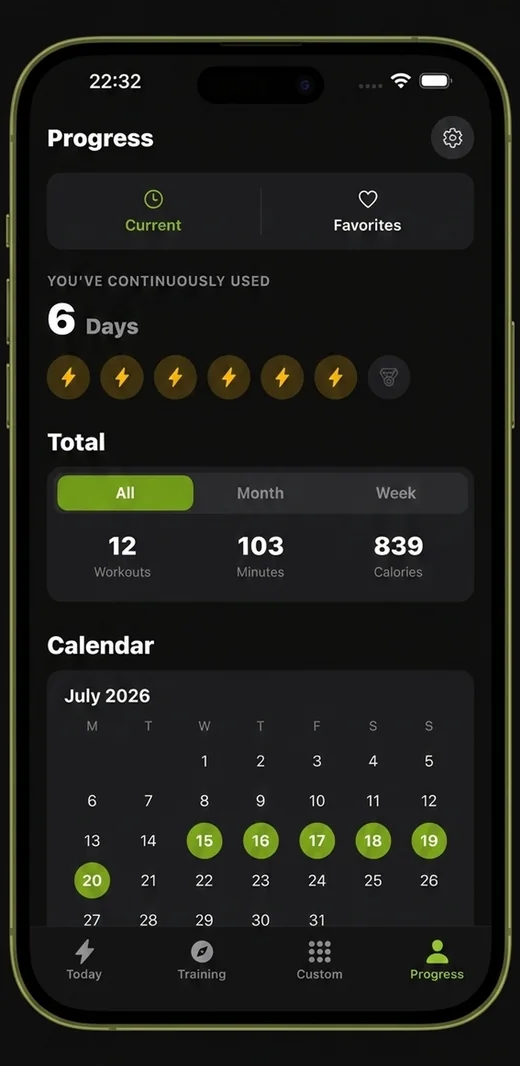
Military Calisthenics Coach is a 21-day military-style calisthenics program for iPhone: one guided bodyweight workout a day, with timed sets and rests, ranks and streaks. It is a separate program from the guides on this site.
- A 21-day military-style program, one workout a day
- Guided timed sessions — no counting, no guessing
- Build your own sessions by time, body zone or focus



The Bulgarian split squat is a one-leg squat with your back foot resting on a bench behind you. You lower your back knee toward the floor and stand back up with your front leg doing almost all the work. With bodyweight, aim for 3 sets of 12 per leg with your rear foot on a bench at about shin height. Once you can do that, slow the reps down or add load.
This guide covers what the exercise trains, how to set up the bench and your stance, how to shift the work toward quads or glutes, what the research says about the common claims, a placement test and a five-stage progression.
What the Bulgarian split squat trains
The front leg is the working leg. The back leg mostly helps you balance.
| Muscle | Role |
|---|---|
| Quads (vastus lateralis, vastus medialis, rectus femoris) | Straighten the front knee as you stand up |
| Glutes (gluteus maximus) | Straighten the front hip; work hardest near the bottom |
| Hamstrings (biceps femoris) | Help straighten the hip; more active than in a regular split squat |
| Gluteus medius | Holds the pelvis level and the knee in line |
| Calves and foot muscles | Keep you balanced on one foot |
Setup: bench height and stance
Bench height. Lab studies used a 40 cm (about 16 in) box, a bench set to each person’s shin length (knee joint to ankle bone), or a box at about kneecap height. Anything in that range works: a weight bench, a low wall, a sturdy chair or a sofa. If your back knee cannot get near the floor, or the front of your back hip pulls hard at the bottom, go lower. A stair step is a good start.
Stance length. In the 2025 stance study, the front toes were placed 100% or 130% of leg length in front of the back-foot support, measured to the toes. Leg length there meant the distance from the bony point on the side of your hip to the outer ankle bone. To set up the shorter of the two tested stances:
- Measure that distance once with a tape measure or a piece of string.
- Put your front toes that far in front of the bench’s front edge, then place the top of your back foot on the bench behind you.
- Do one slow rep. If your front heel lifts at the bottom, step the front foot forward. If you feel stretched out like a lunge and cannot get deep, step it back.
For the longer stance, add about 30% to that distance. Mark the spot with tape so your stance stays the same from session to session.
Back foot. Laces flat on the bench or toes tucked both work. Pick whichever lets you balance without cramping. Feet stay about hip-width apart side to side, not on one line, or you will wobble.
How to do a Bulgarian split squat
- Set up as above, standing tall, hands on your hips or holding something for balance.
- Lower by bending both knees. Go straight down, not forward, so your back knee drops toward the floor. Take about two seconds. In a shorter stance, the front knee travels further forward; that is fine as long as the heel stays down.
- Reach depth. Stop with the back knee just above the floor or lightly touching a pad. Keep your front heel down.
- Stand up by pushing through the whole front foot until the front knee is straight.
- Finish all reps on one leg, then switch. Start with your weaker leg (the side that feels harder) and do the same number of reps on the other one.
Muscle activity in this exercise peaks near the bottom of the rep. In a study of 20 women with resistance-training experience doing reps at 80% of their max, the gluteus maximus, vastus lateralis and both hamstring muscles measured were most active in the bottom third of the rear-foot-elevated split squat. Cutting depth short removes the part of the rep that does the most work.
Four findings from the research
- It really is a one-leg exercise. In a study of 26 recreationally trained men, during an incremental test up to their 5-rep max, the front foot produced about 84% of the vertical force across 715 reps. The back foot carried little more than the weight of the back leg itself.
- It is hip dominant. In a comparison with the back squat in 20 trained men, both exercises loaded the hip most. The Bulgarian split squat, done with half the load (35% vs 70% of back squat max), had lower hip and knee demands and less knee bend.
- It trains more hamstring than a split squat. Two separate EMG studies found higher biceps femoris activity with the rear foot elevated than with both feet on the floor.
- Stance length changes the work. A 2025 study of nine trained men doing bodyweight reps on a 40 cm box compared a long and a short stance. In the long stance the front hip worked about 30% harder (94 vs 73 Nm at the bottom) and the knee less (25 vs 39 Nm).
Quads or glutes: two variables
Stance length and torso angle both change the exercise, but the evidence behind them is different.
| Goal | What to change | Evidence |
|---|---|---|
| More quads (knee) | Shorter stance | Knee moment 39 vs 25 Nm in the short vs long stance (one study, 9 men) |
| More glutes and hamstrings (hip) | Longer stance | Hip moment 94 vs 73 Nm in the long vs short stance (same study) |
| More glutes and hamstrings (hip) | Lean forward about 40 degrees | Higher gluteus maximus and biceps femoris activity (one study, 21 women) |
Stance. In the nine-man study, the long stance moved work from the knee to the hip. The same study also tested leaning about 10 degrees more or less than natural: more lean raised the hip moment in both stances, and less lean lowered it in the short stance. With knee travel held constant, leaning more or less left the knee moment almost unchanged. It is a single small study, so treat it as a useful cue rather than a rule.
Lean. In the 2025 study of 21 female athletes, a 40-degree lean increased activity in the gluteus maximus, biceps femoris and rectus femoris. Vastus lateralis and vastus medialis, the other two quad muscles measured, did not change significantly. The rectus femoris result did not hold in the suspension-strap version of the study, so the clear finding is more glute and hamstring work.
Staying upright to bias the quads is a common coaching cue, but these two studies do not support it. In Aygun-Polat 2025, the upright version did not significantly raise quad activity. In Arakawa 2025, torso angle barely changed the knee moment, while the shorter stance raised it.
Every setup trains both muscle groups. For general leg training, use a moderate stance and the natural lean you fall into, and change it only if you have a specific goal.
What the research says about common claims
| Claim | What the studies found | Strength of evidence |
|---|---|---|
| Works one leg at a time | The front foot produced 84% of vertical force (Helme 2022, 26 men, 715 reps) | Moderate: one study |
| Trains more hamstring than a split squat | Higher biceps femoris activity with the rear foot elevated (DeForest 2014, 9 men; Mausehund 2019, 11 people) | Moderate: two small studies that agree |
| Leaning forward targets the glutes | 40-degree lean raised glute max, biceps femoris and rectus femoris activity (Aygun-Polat 2025, 21 women) | Moderate: one study, and muscle activity is not the same as growth |
| Easier on the knees than squats | Less knee bend and lower knee and hip demands than the back squat, with the Bulgarian split squat at half the load: 35% vs 70% of back squat max (Mackey 2021, 20 trained men) | Limited: healthy lifters, not people with knee pain |
| As good as back squats for athletes | Similar gains in back squat strength, 40 m sprint and agility after 5 weeks of either exercise (Speirs 2016, 18 rugby players). A meta-analysis of 14 studies found one-leg training better for one-leg jumps and two-leg training better for two-leg strength (Liao 2022) | Moderate |
| More hip work with less weight | At each lifter’s 10-rep max, hip extension moment was 44% higher at the bottom than in the back squat, despite the lighter load (Arakawa 2023, 8 rugby players) | Limited: one small study |
| Fixes left-right imbalances | Ten weeks of extra sets for the non-dominant leg, using one-leg strength exercises (including this one) and one-leg jumps, reduced jump and strength asymmetry compared with a group that kept its usual training (Zhang 2024, 30 basketball players) | Limited: tests a whole program with extra volume, not this exercise alone |
The pattern: the Bulgarian split squat is a studied, effective way to load one leg with little or no equipment. The claims about knees, lighter loads and imbalances come from small studies in healthy, trained people, so they are reasonable expectations, not guarantees. If your front knee hurts, try a longer stance, which lowered the knee moment in the stance study, and a lower bench; if the pain persists, get it checked.
Find your starting stage
After a warm-up, do one set of regular split squats (both feet on the floor) on your weaker leg. If you are not sure which leg is weaker, test both and use the lower count.
- Fewer than 20 clean reps: start at stage 1.
- 20 or more: rest two minutes, then try one set of Bulgarian split squats with the back foot on a stair step. Fewer than 15 clean reps: start at stage 2. Fifteen or more: start at stage 3.
A clean rep reaches full depth with the front heel down. Light fingertip support on a wall for balance is fine and still counts; pulling on it does not.
The five-stage progression
Train it twice a week with at least one rest day between sessions. Do 3 sets per leg and rest 60 to 90 seconds between sets. Move up when you complete the target for all three sets on both legs with clean reps.
| Stage | Exercise | Move up when |
|---|---|---|
| 1 | Split squat, both feet on the floor | 3 × 15 per leg |
| 2 | Low-step Bulgarian split squat, back foot on a stair step | 3 × 12 per leg |
| 3 | Bulgarian split squat, back foot at about shin height | 3 × 12 per leg |
| 4 | Slow Bulgarian split squat: 3 seconds down, 1-second pause at the bottom | 3 × 8 per leg |
| 5 | Loaded Bulgarian split squat, normal tempo | Add load whenever you reach 3 × 12 |
Stage 1: Split squat. The same movement with the back foot on the floor. It teaches the vertical path and the depth before balance gets harder.
Stage 2: Low step. A stair step raises the back foot a few inches. The front leg takes more of the load, and the hip stretch is milder than on a bench.
Stage 3: Bench height. The standard exercise. Use the setup steps above to find your stance, and keep it the same every session so your reps are comparable.
Stage 4: Slow tempo. Lowering for three seconds and pausing removes the bounce and keeps the muscle working through the hardest part of the rep. Fewer reps are needed for the same effort, which is why the target drops to eight.
Stage 5: Add load. Go back to the normal two-second lowering. Hold dumbbells or water jugs at your sides, wear a loaded backpack or use a weighted vest. The muscles worked stay the same; the load just makes each rep harder. Pick a load that allows about 8 clean reps, build to 3 × 12, then add a little more. Our guide to weighted calisthenics covers the options.
The other path from stage 3. If your goal is pure bodyweight training, move from stage 3 to slow pistol squats to a box, the next rung on the knee-dominant ladder in our calisthenics leg workout.
Common mistakes and how to fix them
| What you notice | What is happening | Fix |
|---|---|---|
| Front heel lifts at the bottom | Stance too short | Move the front foot forward |
| Back hip or thigh pulls hard, cannot get deep | Bench too high or stance too long | Use a lower surface or shorten the stance slightly |
| You wobble side to side | Feet on one line | Set the feet about hip-width apart |
| You push off with the back foot | Back leg is helping | Keep the back foot relaxed; lower the bench if needed |
| Front knee drifts inward | Hip muscles losing control | Slow down, lighten the load, and keep the knee over the middle toes |
| Reps get shallow as the set goes on | Fatigue is cutting your depth | Count only reps that reach full depth |
| One leg always gets fewer reps | Normal left-right difference | Start with the weaker leg; match its reps on the stronger side |
Where it fits in a workout
Put Bulgarian split squats first or second in a leg or lower-body session, after the warm-up and while you are fresh. Pair them with an exercise for the back of the legs, such as the Nordic hamstring curl or single-leg hip bridges.
In a push, pull, legs split, they go on leg day as the main single-leg squat. In a full-body routine, they can replace the regular split squat once you have reached 3 × 15.
Frequently asked questions
How high should the bench be for Bulgarian split squats?
Somewhere between shin length and about kneecap height. Lab studies used a 40 cm (about 16 in) box, a bench set to each person’s shin length, or a box at about kneecap height. If your back knee cannot get close to the floor, or you feel a strong pull at the front of the back hip, use something lower such as a step.
Should you lean forward on Bulgarian split squats?
Lean forward if you want more glute and hamstring work. In a 2025 study of 21 female athletes, a 40-degree forward lean raised gluteus maximus and biceps femoris activity. Staying upright did not significantly raise quad activity in that study; in a separate stance study, a shorter stance put more work on the knee. For general training, use the lean you fall into naturally.
Are Bulgarian split squats good for glutes?
Yes. Studies describe the exercise as hip dominant, and a longer stance or a forward lean increases the work at the hip. Glute activity is highest near the bottom of the rep, so use the full depth.
What is the difference between a split squat and a Bulgarian split squat?
In a split squat both feet are on the floor. In a Bulgarian split squat the back foot rests on a bench, which puts more of the work on the front leg: one study found higher peak vertical force on the front leg than in the split squat. Two EMG studies found more biceps femoris (hamstring) activity in the rear-foot-elevated version.
Is the Bulgarian split squat or the Romanian deadlift better?
They train different patterns, so one does not replace the other. The Romanian deadlift is a hip hinge with the knees only slightly bent, so the hamstrings and glutes do most of the work. The Bulgarian split squat bends both the hip and the knee, so it trains the quads as well as the glutes. A balanced leg session uses one exercise of each kind.
How many reps of Bulgarian split squats should I do?
With bodyweight, work up to 3 sets of 12 per leg, two sessions a week, then make it harder with a slower tempo or added load. With load, choose a weight that allows about 8 clean reps and build to 12 before adding more.
Sources
- Helme M, Emmonds S, Low C. Is the rear foot elevated split squat unilateral? An investigation into the kinetic and kinematic demands. Journal of Strength and Conditioning Research, 2022.
- Mackey ER, Riemann BL. Biomechanical differences between the Bulgarian split-squat and back squat. International Journal of Exercise Science, 2021.
- Arakawa H, Nakashima H, Li X, Tanimoto M. Rear leg-derived moment contributes to resistance against hip extension in Bulgarian split squats. International Journal of Exercise Science, 2025.
- Aygun-Polat E, Guzel NA, Guruhan S, Polat Y, Karatas N. Targeted muscle activation in Bulgarian split squat variations: effects of trunk position and suspension-based execution. BMC Sports Science, Medicine and Rehabilitation, 2025.
- DeForest BA, Cantrell GS, Schilling BK. Muscle activity in single- vs. double-leg squats. International Journal of Exercise Science, 2014.
- Mausehund L, Skard AE, Krosshaug T. Muscle activation in unilateral barbell exercises: implications for strength training and rehabilitation. Journal of Strength and Conditioning Research, 2019.
- McCurdy K, Walker J, Kelly C, Polinski M. Hip and knee extensor activation during the hip thrust and rear-foot-elevated split squat in trained females. Journal of Strength and Conditioning Research, 2021.
- Arakawa H, Mori M, Tanimoto M. Greater hip moments in rear-foot-elevated split squats than in conventional back squats with the same relative intensity of loads. Journal of Strength and Conditioning Research, 2023.
- Speirs DE, Bennett MA, Finn CV, Turner AP. Unilateral vs. bilateral squat training for strength, sprints, and agility in academy rugby players. Journal of Strength and Conditioning Research, 2016.
- Liao KF, Nassis GP, Bishop C, Yang W, Bian C, Li YM. Effects of unilateral vs. bilateral resistance training interventions on measures of strength, jump, linear and change of direction speed: a systematic review and meta-analysis. Biology of Sport, 2022.
- Zhang W, Chen X, Xu K, et al. The potential of a targeted unilateral compound training program to reduce lower limb strength asymmetry and increase performance: a proof-of-concept in basketball. Frontiers in Physiology, 2024.