The Calisthenics Leg Workout
Bodyweight leg training that keeps working after squats get easy — single-leg loading, hamstring work, and the pattern most routines skip.
On iPhone

Military Calisthenics Coach
Take the drill with you
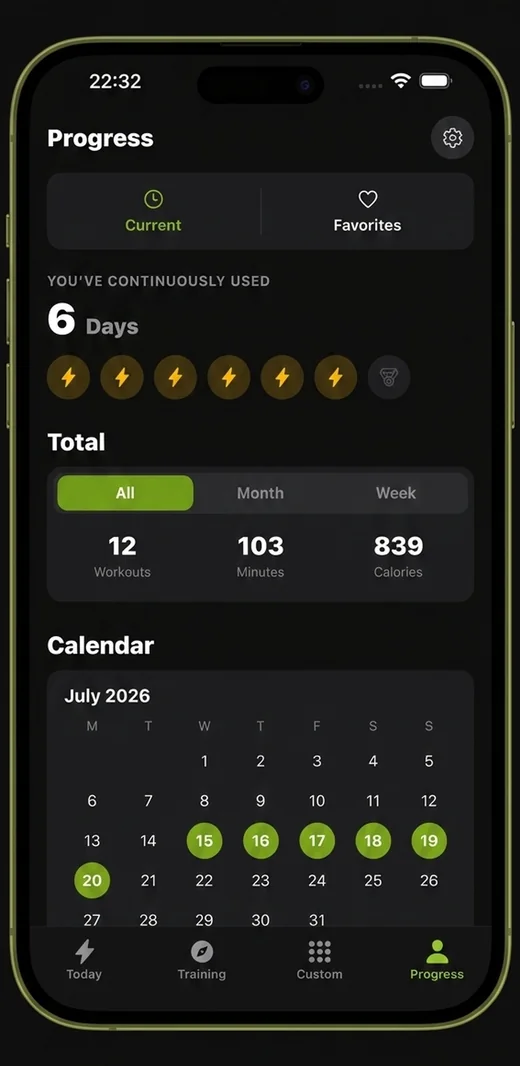
Everything on this site, built into a pocket coach. Military Calisthenics Coach turns the standards into a daily session you can run in a barracks, a garage or a hotel room — timed, tracked and scaled to you.
- A 21-day program that adapts to your level
- Guided timed sessions — no counting, no guessing
- Ranks, streaks and progress you can actually see



Skipping legs is a calisthenics cliché for a reason. The leg movements are harder to learn than push-ups, they photograph badly, and air squats stop being challenging so quickly that many people conclude bodyweight leg training does not work. It works. It just requires the same thing everything else does: fewer limbs, not more reps.
The problem with air squats
Your legs carry your bodyweight all day. Asking them to do it fifty more times in a row is conditioning — useful, but not a growth stimulus. Once you pass roughly thirty clean reps, adding more does very little for strength or size.
The fix is not a heavier body. It is a smaller base: put most of your weight on one leg and the load doubles instantly.
The session
Fifteen minutes, twice a week, or folded into a full-body session as movements three and five of the best calisthenics workout.
| Movement | Sets × reps | Trains |
|---|---|---|
| Split squat | 3 × 10–15 each leg | Quads, glutes |
| Nordic curl negative | 3 × 5–8 | Hamstrings |
| Single-leg hip bridge | 3 × 10–12 each leg | Glutes, hamstrings |
| Calf raise, one leg | 3 × 15–20 each leg | Calves |
Rest 60 seconds between sets. That is a complete lower body: knee-dominant, hip-dominant, and the calves, which respond to little else.
The knee-dominant ladder
| Rung | Movement | Target |
|---|---|---|
| 1 | Sit-to-stand from a chair | 3 × 15 |
| 2 | Bodyweight squat | 3 × 20 |
| 3 | Split squat | 3 × 15 per leg |
| 4 | Bulgarian split squat (rear foot elevated) | 3 × 12 per leg |
| 5 | Slow pistol squat to a box | 3 × 8 per leg |
| 6 | Full pistol squat | 3 × 5 per leg |
| 7 | Shrimp squat | 3 × 5 per leg |
Take the rungs in order and do not rush past three — the split squat is where most of the strength actually gets built, and a pistol attempted from a weak split squat is a balance exercise rather than a strength one.
The hinge nobody trains
Squats train the knee. They barely touch the hamstrings, which work by extending the hip and flexing the knee — and if you never train them, you build a body that is strong in front and neglected behind. It shows up as poor sprinting, cranky knees and a back that dislikes bending.
The Nordic curl is the answer. Kneel on something soft, anchor your heels under a sofa or have a partner hold them, squeeze your glutes so your body makes one line from knee to head, and lower your chest toward the floor as slowly as you can. Catch yourself on your hands and push back to the start.
Almost nobody manages a controlled full descent at first. Three seconds is a good beginning; the goal is six, and eventually pulling yourself back up.
Single-leg hip bridges are the easier hinge option and belong in every programme regardless: one foot planted, the other leg lifted, hips driven up to a straight line from shoulder to knee, with a one-second pause at the top.
Mobility is part of the strength
A pistol squat requires enough ankle dorsiflexion to keep your heel down with the knee well past the toes. Many people are stopped by ankles rather than legs and spend months adding strength to a movement that is not strength-limited.
Test it: kneel in a lunge, front foot flat, and push the knee forward over the toes without the heel lifting. If the knee travels less than about 10 cm past the toes, spend two minutes a session on that stretch. It is usually worth more than the extra set.
How it fits the week
Twice a week is plenty. Legs recover more slowly than the upper body, and split squats in particular produce soreness that will affect the next two days — which is a good reason to keep them on the same three-sessions-a-week schedule the 4-week plan uses rather than adding a dedicated leg day.