A Calisthenics Core Workout Built on Holds
Why the hollow hold beats the sit-up, and a ten-minute core session that feeds directly into every advanced bodyweight skill.
On iPhone

Military Calisthenics Coach
Take the drill with you
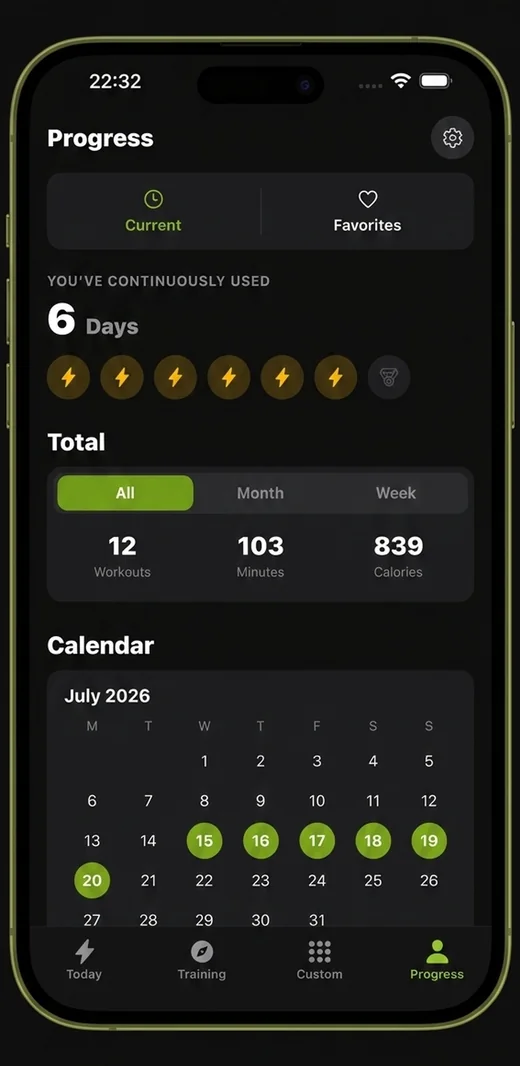
Everything on this site, built into a pocket coach. Military Calisthenics Coach turns the standards into a daily session you can run in a barracks, a garage or a hotel room — timed, tracked and scaled to you.
- A 21-day program that adapts to your level
- Guided timed sessions — no counting, no guessing
- Ranks, streaks and progress you can actually see



The core’s job in calisthenics is not to bend. It is to refuse to bend while something else happens — while you hang, press, lever or invert. That single observation is why the best bodyweight core work is made of holds rather than crunches, and why a hollow hold does more for your training than a hundred sit-ups.
The one position that matters
The hollow hold is the shape underneath almost every advanced calisthenics skill. A handstand is a vertical hollow. A front lever is a horizontal one. A planche is a hollow with the shoulders pushed forward. Learn the position properly and each of those becomes a question of strength rather than of figuring out what to do with your spine.
How to find it:
- Lie on your back, knees tucked, arms by your sides.
- Press your lower back flat into the floor. Flat — no gap, not even a finger’s worth.
- Keeping that contact, lift your shoulder blades an inch off the floor and lift your feet.
- Slowly extend the legs. Stop at the point where the lower back starts to lift away from the floor. That is your hollow hold.
Almost everyone’s first honest hollow hold is much more tucked than they expect. That is fine. The extension comes with weeks, and a tucked hold with a flat back is worth more than a straight one with an arch.
The session
Ten minutes, two or three times a week, at the end of a training session.
| Movement | Sets | Work | Rest |
|---|---|---|---|
| Hollow hold | 3 | 20–40 sec | 45 sec |
| Hanging knee raise | 3 | 8–12 reps | 45 sec |
| Side plank | 2 per side | 30–45 sec | 30 sec |
| Hollow rock | 2 | 20–30 sec | 45 sec |
Everything here is either a hold or a slow, controlled rep. Nothing is fast, and nothing involves throwing your torso at your knees.
Why not sit-ups
Two reasons, neither of them dramatic.
First, range. A sit-up trains the abdominals through a short, flexed range that they are already good at. A hollow hold and a hanging leg raise train them lengthened and under tension, which is where growth and transferable strength come from.
Second, repetition cost. Hundreds of daily sit-ups put the lumbar spine through hundreds of daily flexion cycles for a training effect you can get in three 30-second holds. That is a poor trade for most people, and a bad one for anyone whose back already complains.
Sit-ups are not dangerous. They are just an inefficient use of a slot in your programme.
The progression
| Rung | Movement | Target |
|---|---|---|
| 1 | Tucked hollow hold | 3 × 30 sec |
| 2 | One leg extended | 3 × 30 sec per side |
| 3 | Full hollow hold | 3 × 40 sec |
| 4 | Hollow hold, arms overhead | 3 × 30 sec |
| 5 | Hanging tucked leg raise | 3 × 12 |
| 6 | Hanging straight-leg raise | 3 × 10 |
| 7 | Toes to bar | 3 × 8 |
| 8 | Tucked front lever hold | 3 × 15 sec |
Rungs 1 to 4 belong in your first months; the hollow hold is movement six of the best calisthenics workout for exactly that reason. Rungs 5 to 7 come once you can hang comfortably for a minute. Rung 8 is where core training turns into skill training — see the muscle-up and handstand guides for what it unlocks.
About visible abs
Core training makes the muscles stronger and somewhat larger. Whether you can see them is decided almost entirely by how much fat covers them, which is a question of total energy balance over months, not of core exercises. Nobody has ever trained a six-pack into visibility from the top down.
Train the core because it makes everything else on this site possible. Treat the appearance as a side effect of the eating, not a goal of the session.
Where it goes in the week
Two or three times a week, at the end of a workout rather than the start — a fatigued core makes every preceding movement sloppier and slightly more dangerous. In the 4-week plan that means the hollow hold closes every session, which is exactly where it belongs.