Chin-Ups: Form, Muscles Worked and a 5-Stage Progression
How to do a strict chin-up, what the EMG studies say about chin-ups vs pull-ups, a quick test to find your stage, and a five-stage progression from dead hang to 10 reps.
On iPhone

Military Calisthenics Coach
Take the drill with you
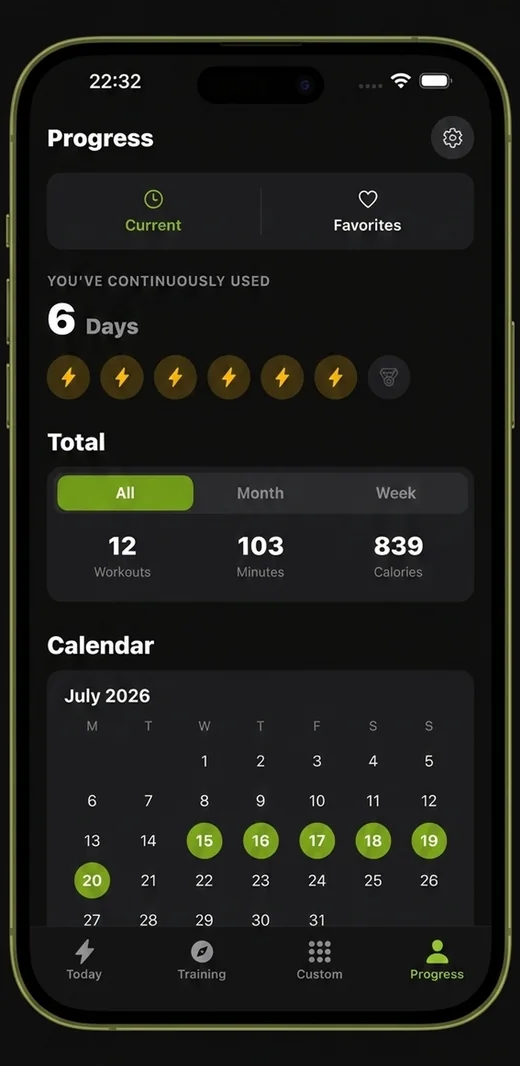
Military Calisthenics Coach is a 21-day military-style calisthenics program for iPhone: one guided bodyweight workout a day, with timed sets and rests, ranks and streaks. It is a separate program from the guides on this site.
- A 21-day military-style program, one workout a day
- Guided timed sessions — no counting, no guessing
- Build your own sessions by time, body zone or focus



A chin-up is a pull-up done with an underhand grip: palms facing you, hands about shoulder-width apart. You start from a dead hang with straight arms and pull until your chin clears the bar, then lower all the way back down. It trains the lats about as hard as an overhand pull-up does, and your arms are stronger in this grip, which is likely why the chin-up is often the easier first rep. Build to it through hangs, rows and slow negatives, then take it to 4 sets of 10 strict reps.
This guide covers how to do a strict rep, what the research says about chin-ups vs pull-ups, the muscles involved, a quick test to find your starting stage, and a five-stage progression to 10 reps.
How to do a chin-up
- Grip the bar underhand, hands about shoulder-width apart, thumbs wrapped around the bar.
- Hang with straight arms. Feet off the floor, legs together, a slight tension in the abs so you do not swing.
- Pull the shoulders down first. Draw your shoulder blades down away from your ears without bending the elbows. Your body rises slightly.
- Drive the elbows down toward your ribs. Keep them in front of you, not flared out wide. Lead with the chest, not the chin.
- Finish with the chin over the bar. Do not crane your neck to get it there; the head stays in line with the body.
- Lower under control until your arms are fully straight again. Take two to three seconds on the way down.
A rep only counts if it starts from straight arms and the chin clears the bar. Anything shorter is a partial rep, and partials skip the bottom of the movement, the part a first chin-up needs most.
Chin-up vs pull-up: what actually differs
The main change is the grip. The muscles involved are the same; the grip shifts how much each one contributes.
| Chin-up | Pull-up | |
|---|---|---|
| Grip | Underhand (palms facing you) | Overhand (palms facing away) |
| Hand width | About shoulder-width | Shoulder-width or wider |
| Elbow path | In front of the body | More out to the sides |
| More active in Youdas 2010 | Biceps, pecs | Lower trapezius |
| Lats | No significant grip difference reported | No significant grip difference reported |
Three studies are worth knowing here:
- Youdas and colleagues (2010) measured muscle activity in 25 people (21 men, 4 women) doing a pull-up, a chin-up and a pull-up on rotating handles. The lats were the most active muscle, at 117 to 130% of a maximal test contraction across the three exercises. The biceps and pecs were significantly more active in the chin-up; the lower trapezius was more active in the pull-up.
- Dickie and colleagues (2017) tested 19 strength-trained men on pull-ups with underhand, overhand, neutral and rope grips. Over a full rep, activity in the eight muscles they measured was similar across hand positions. The only grip difference they reported was more middle trapezius in the overhand grip than the neutral grip.
- Kohn and colleagues (2018) measured how hard 11 young men could bend the elbow in a seated strength test, not on a bar, with the forearm in different positions. Palms up produced about 214 N, palms facing each other about 244 N, and palms down only about 114 N, roughly half.
Put together: the lats work about equally in both grips. The two EMG studies disagree on the arms: Youdas found more biceps activity in the chin-up, while Dickie, testing trained men, found no grip difference. What is clear is that the chin-up puts your elbow flexors in a strong position. That is the likely reason many people find it easier than an overhand pull-up.
Which should you train?
- No pull-up yet: start with the chin-up. It is the same pulling pattern, in a grip where your elbow flexors are much stronger.
- You can do both: do both. Put the harder one first while you are fresh, or run one for a few weeks and then switch. Your lats get similar work either way.
- The underhand grip hurts your wrists or elbows: use a neutral grip (palms facing each other) on parallel handles or rings. In the Kohn study it was at least as strong as the underhand grip.
- Your goal is the muscle-up: spend most of your sets on overhand pull-ups, because the bar muscle-up is done with an overhand grip.
Muscles worked
| Muscle | Role in the chin-up |
|---|---|
| Latissimus dorsi | Pulls the upper arms down and back; the most active muscle in both grips |
| Biceps brachii and brachialis | Bend the elbows; in one of the two EMG studies, the biceps worked harder with palms facing you |
| Pectoralis major | Helps pull the arms down from overhead; more active in the chin-up in one of the two EMG studies |
| Lower trapezius | Pulls the shoulder blades down at the start of the rep |
| Infraspinatus (rotator cuff) | Steadies the shoulder joint |
| Abs and obliques | Keep the body still so you do not swing |
Youdas and colleagues also saw a general pattern in timing: the lower trapezius and pecs peaked early in the rep, and the biceps and lats toward the end. That fits the common coaching cue to start each rep by pulling the shoulders down from your ears.
Find your starting stage
Test yourself once, rested, on the bar you will train on. Start at the first row you cannot pass. If you can already do one to four strict chin-ups, skip the negative test and start at stage 4. This is a one-set placement check, so if your first week at the new stage feels too hard to hit its targets, drop back one stage.
| Test | Pass | If you fail, start at |
|---|---|---|
| Underhand dead hang, then scapular pulls | 30 seconds, then 8 pulls | Stage 1 |
| Underhand Australian row, body horizontal | 12 reps | Stage 2 |
| Chin-up negative | 3 reps, each lowered over 5 seconds | Stage 3 |
| Strict chin-up | 5 reps | Stage 4 |
| Pass all four | Stage 5 |
The five-stage chin-up progression
Train stages 1, 2, 3 and 5 two or three times a week. Move up when you hit the target with clean form on every set.
| Stage | Exercise | Move up at |
|---|---|---|
| 1 | Underhand dead hang and scapular pulls | 3 × 30 sec hang and 3 × 8 scapular pulls |
| 2 | Underhand Australian row | 3 × 12 with the body horizontal |
| 3 | Chin-up negative | 4 × 3, each lowered over 5 seconds |
| 4 | First chin-up, then greasing the groove | 5 strict reps in one set |
| 5 | Chin-up sets | 4 × 10 |
Stage 1: Dead hang and scapular pulls
Hang from the bar with an underhand grip and straight arms, shoulders pulled gently down rather than shrugged up to your ears. Grip often gives out before the back does, and there is no chin-up without holding on.
After the hangs, do scapular pulls: from the dead hang, pull your shoulder blades down without bending the elbows, hold for a second, and lower. This is step 3 of the full chin-up done on its own.
Stage 2: Underhand Australian row
Hang underneath a low bar, such as a bar in a squat rack or a low park bar. Grip underhand, keep the body straight from heels to head, and pull your chest to the bar. Start with the bar around waist height or with bent knees. For the stage target, the bar has to be low enough that your body is level with the floor at the bottom of the rep, or put your heels on a box.
This builds the same pulling pattern with only part of your bodyweight, and it stays useful as a high-rep back exercise long after you can do chin-ups.
Stage 3: Chin-up negative
Step or jump up until your chin is over the bar, holding it underhand. Then lower yourself as slowly as you can until your arms are straight. Aim for five seconds, and keep the speed even rather than dropping through the bottom half. Step back up and repeat. Rest two minutes between sets.
Dickie and colleagues found more activity in the biceps, brachioradialis and pecs on the way up than on the way down, so negatives are not a replacement for the real thing. They are a bridge: they train the full range at the speed you can control until you can lift yourself through it.
Stage 4: First rep, then greasing the groove
When your negatives are slow all the way down, try a full chin-up from a dead hang. If you stall halfway, go back to negatives for another week or two rather than practicing half reps.
Once you have one rep, build to five with greasing the groove: several small sets spread through the day, never to failure. Until your best set is four reps, practice single reps, and stop for the day as soon as one slows down or grinds. From four reps on, keep each set to about half your best set, rounded down. A typical starting point is five or six sets a day on most days of the week. Retest your max once a week.
Stage 5: Chin-up sets
Now train in sets. Your starting target is your best single set minus two reps, so a best set of 5 means 4 × 3. Rest about two minutes between sets. When all four sets hit the target with clean reps, add one rep to each set next session. When you reach 4 × 10, you have the base for harder work.
Common mistakes
| What you see | What causes it | Fix |
|---|---|---|
| Reps start with bent arms | Skipping the bottom of the range | Lower to straight arms on every rep; count only full reps |
| Chin pokes up to reach the bar | The body did not get high enough | Lead with the chest; end the set when the chin cannot clear without craning |
| Shoulders shrug up to the ears at the bottom | The rep starts with the arms instead of the shoulders | Pull the shoulder blades down first, as in the scapular pull |
| Body swings or legs kick | Using momentum to get through the sticking point | Squeeze the legs together, brace the abs, and slow the lowering |
| Fast drop on the way down | Treating the lowering as rest | Take two to three seconds down on every rep |
| Wrists or inner elbows ache | The underhand grip does not suit your joints | Switch to a neutral grip, or alternate grips between sessions |
Where chin-ups fit in a workout
Chin-ups belong early in a session, after a warm-up and while you are still fresh. If you also train pull-ups that day, do the harder of the two first. In our push-pull-legs split, the pull day already includes chin-ups as the second vertical pull, at 3 × 6 to 10 after pull-ups and Australian rows. In a full-body session, pair them with a push exercise such as dips or push-ups and alternate sets.
If you also want overhand pull-ups, the pull-up progression uses a similar ladder of hangs, rows and negatives with an overhand grip. You do not need to finish one before starting the other.
Past 4 × 10, the next steps are paused reps (hold the chin over the bar for two seconds), weighted chin-ups, and eventually single-arm work. If the muscle-up is your goal, shift most of your pulling to overhand pull-ups and work on pulling the chest, not the chin, to the bar.
Frequently asked questions
What muscles do chin-ups work?
The lats do the most work, with the biceps and brachialis bending the elbows. The pecs, lower trapezius and rotator cuff help move and steady the shoulder, and the abs keep you from swinging. In the Youdas 2010 study, the chin-up produced more biceps and pec activity than the overhand pull-up; a 2017 study in trained men found no grip difference in those muscles.
Are chin-ups easier than pull-ups?
They often feel easier, and the likely reason is the grip. With the palms facing you, the elbow flexors are much stronger: in a seated lab test, men produced about 214 N of elbow-bending force with the palms up and about 114 N with the palms down. No study we found measured first-rep success on each, so test both.
Is it okay to do chin-ups and pull-ups in the same workout?
Yes. They train the same muscles with a different grip, so treat them as one pulling block. Do the harder of the two first while you are fresh, then the other, and count both toward your weekly pulling sets.
How many chin-ups should I be able to do?
We could not find reliable population averages, and the figures quoted online rarely cite a source. A practical scale: one strict rep means you are past the beginner stages, five means you can start training in sets, and ten strict reps from a dead hang is a solid intermediate target.
Are chin-ups good for building biceps?
They load the biceps hard for a compound exercise. In the Youdas 2010 EMG study they did so more than an overhand pull-up, though Dickie 2017 found no grip difference in trained men. We could not find a training study comparing biceps growth from chin-ups alone with curls, so if bigger arms are the main goal, chin-ups plus some direct arm work is the safer bet.
How often should I do chin-ups?
Two or three times a week, with at least a day between sessions, for the strength stages. The exception is greasing the groove at stage 4: small sets spread through the day, never to failure, which you can do most days.
Sources
- Youdas JW, Amundson CL, Cicero KS, et al. Surface electromyographic activation patterns and elbow joint motion during a pull-up, chin-up, or Perfect-Pullup rotational exercise. Journal of Strength and Conditioning Research, 2010.
- Dickie JA, Faulkner JA, Barnes MJ, Lark SD. Electromyographic analysis of muscle activation during pull-up variations. Journal of Electromyography and Kinesiology, 2017.
- Kohn S, Smart RR, Jakobi JM. Voluntary activation and twitch potentiation of the elbow flexors across supinated, neutral, and pronated forearm orientations. Physiological Reports, 2018.