Hanging Leg Raises: Form, Muscles Worked and a 6-Stage Progression
How to do hanging leg raises so your abs do the work instead of your hip flexors, what the research says about them, and a six-stage progression from knee raises to strict toes-to-bar.
On iPhone

Military Calisthenics Coach
Take the drill with you
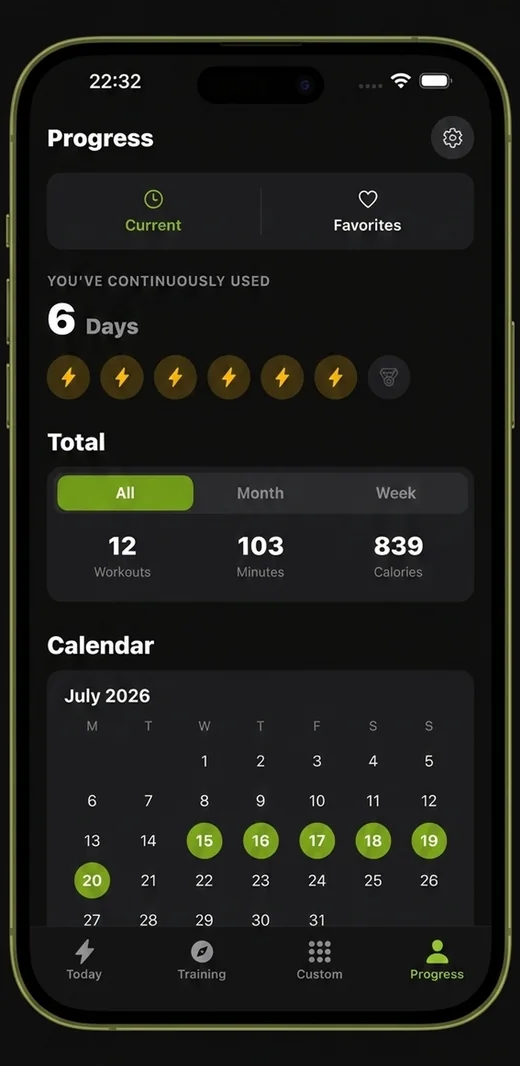
Military Calisthenics Coach is a 21-day military-style calisthenics program for iPhone: one guided bodyweight workout a day, with timed sets and rests, ranks and streaks. It is a separate program from the guides on this site.
- A 21-day military-style program, one workout a day
- Guided timed sessions — no counting, no guessing
- Build your own sessions by time, body zone or focus



Hanging leg raises are a core exercise done from a pull-up bar: hang at arm’s length, then lift your legs in front of you, either bent or straight, and lower them under control. Done well, they are one of the hardest-working ab exercises measured in the lab. Done the way most people do them, swinging and lifting only to parallel, they mostly train the hip flexors and your grip.
This guide covers what the exercise trains, the one form change that moves the work onto your abs, a six-stage progression from knee raises to toes-to-bar, and how to fit it into a week.
What hanging leg raises train
Two muscle groups share the work, and the split between them is the most misunderstood part of the exercise.
| Muscle | Role |
|---|---|
| Hip flexors (iliopsoas, rectus femoris) | Lift the legs. This is their main job |
| Rectus abdominis | Holds the trunk still, then curls the pelvis up, if you lift past parallel |
| Obliques | Stop the body twisting and help curl the pelvis |
| Lats and shoulders | Keep you stable on the bar and stop you swinging |
| Forearms and grip | Hold you up for the whole set |
The rectus abdominis runs from the pubic bone to the lower ribs and breastbone. It does not cross the hip, so it cannot lift your legs. What it can do is pull the pelvis up toward the ribs, tilting it backward and rounding the lower back. Lifting the legs to parallel is hip flexion, and the hip flexors do it while the abs hold the trunk steady. The abs become the movers once the pelvis starts to curl, which mostly happens from parallel upward.
That is why two people can do “the same” exercise and get very different results. One lifts the feet to waist height and feels it in the front of the hips. The other lifts a little higher, curls the hips up toward the bar, and feels it in the lower abs.
What the research says
Two studies are worth knowing:
- McGill and colleagues (2015) measured three whole-body core exercises in 14 men. The hanging straight-leg raise produced the highest abdominal activation of the three: over 130% of maximum voluntary contraction in the rectus abdominis and 88% in the external obliques. It also produced more spine compression than the body saw: about 3,000 newtons against under 2,500.
- Escamilla and colleagues (2006) compared traditional and gadget-based ab exercises in 21 adults. The hanging knee-up, done with arm straps, was among the most effective for rectus abdominis and oblique activity, alongside the Power Wheel and an inclined reverse crunch, and ahead of the traditional crunch and bent-knee sit-up.
Both are small studies, and muscle activation is not the same as muscle growth. But they agree on the direction: hanging leg raises load the abs heavily. The McGill data also shows the cost. If you have a history of low back trouble, get it checked before training the straight-leg versions, and stay on the bent-knee stages until they feel comfortable.
Are you ready for it?
You need a bar you can hang from with your feet clear of the floor. Then check the standards below:
| Test | Standard |
|---|---|
| Dead hang, for stages 1 and 2 | 30 seconds, shoulders active (not shrugged to the ears) |
| Dead hang, for stages 3 to 6 | 60 seconds, same form |
| Hollow body hold on the floor | 20 seconds, lower back pressed down |
Grip is the usual limit. If you cannot hang for 30 seconds, practice dead hangs for a few weeks; the first stages of our pull-up progression build exactly that. If the hollow hold is the problem, the calisthenics core workout builds it. A captain’s chair (elbows on pads, back against a rest) or lying leg raises let you train the same movement in the meantime.
How to do a hanging leg raise
- Grip the bar overhand, about shoulder-width apart.
- Set the shoulders. Pull them slightly down, away from your ears, so you are not hanging loose in the joint. Arms stay straight.
- Kill the swing. Squeeze your glutes and let your feet drift slightly in front of the bar. Start each rep from a still position.
- Lift the legs in front of you, knees bent or straight depending on your stage. Breathe out as you lift.
- Curl the pelvis at the top. As your thighs pass parallel, keep going by lifting your hips toward the bar, as if showing your tailbone to the wall in front of you. This is the part that trains the abs.
- Lower slowly, about three seconds, until the legs are straight down. Pause long enough to stop any swing before the next rep.
Tempo is roughly two seconds up, a brief pause, three seconds down. If you need momentum to reach the top, the stage is too hard.
The six-stage progression
Train two or three times a week. Move up when you hit the target on the right for every set with clean form: no swing, controlled lowering, pelvis curling at the top.
| Stage | Exercise | Move up at |
|---|---|---|
| 1 | Hanging knee raise to parallel | 3 × 12 |
| 2 | Hanging knee raise with pelvic curl | 3 × 10 |
| 3 | Tuck up, straight-leg lower | 3 × 8 |
| 4 | Straight-leg raise to parallel | 3 × 10 |
| 5 | Straight-leg raise with pelvic curl | 3 × 8 |
| 6 | Strict toes-to-bar | 3 × 5, then add reps |
Stage 1: Knee raise to parallel. Bend the knees and lift until your thighs are parallel to the floor, then lower slowly. This teaches you to stay still on the bar. It is mostly a hip flexor and grip exercise at this point, and that is fine.
Stage 2: Knee raise with pelvic curl. Same start, but keep going past parallel: bring the knees toward your chest by rolling the hips up. Your lower back rounds slightly at the top. This is the first stage where the abs are clearly the movers, and the stage most people should spend the longest on.
Stage 3: Tuck up, straight-leg lower. Raise the knees to the chest as in stage 2, straighten the legs in front of you at the top, then lower them straight as slowly as you can. The lowering phase builds the strength for straight-leg raises before you can lift them.
Stage 4: Straight-leg raise to parallel. Legs straight, lift them until your body makes an L, then lower. For most people the longer lever makes this harder than stage 2, even though the range is shorter. Hamstring flexibility matters here; a slight knee bend is better than swinging.
Stage 5: Straight-leg raise with pelvic curl. Lift past the L by curling the pelvis, until your feet are above your hips. This is the hardest common variation short of toes-to-bar.
Stage 6: Strict toes-to-bar. Continue the curl until your feet touch the bar between your hands. Press down on the bar with straight arms as the legs rise; the lats help lift the hips. Your torso will tilt back a little near the top, but the hips must keep rising with it. No kipping: in a strict rep you could stop at any point and hold.
Making it harder after stage 6
Slow the lowering to five seconds, hold a 2-second pause with the feet at the bar, or add load with light ankle weights. Each makes the exercise harder without changing the movement you have already learned.
Common mistakes
Swinging. Momentum from the previous rep does the lifting for you. Pause at the bottom of every rep until you are still.
Stopping at parallel. Lifting to an L and stopping keeps the work on the hip flexors. If you want the exercise for your abs, the reps need the pelvic curl.
Throwing the torso back to reach the bar. A big backward lean gets the feet higher without curling the spine. The feet go up but the abs do less. A small tilt near the top is normal; the hips should do most of the rising.
Dropping the legs. The lowering is half the exercise. If the legs fall, the set is over.
Passive shoulders. Hanging loosely with the shoulders up by the ears makes the body swing and the shoulders work in a poor position. Set them before every set.
Where it fits in a workout
Hanging leg raises work best as the core block near the end of a session:
- Warm-up, including a 20-second dead hang.
- Main strength work, such as pull-ups, dips and push-ups.
- Hanging leg raises: 3 or 4 sets of 6 to 12 reps, 60 to 90 seconds rest.
- Optional: a hollow body hold or plank to finish.
Grip is shared with pulling, so do them after your pull-ups, not before. On a push-pull-legs split they sit at the end of pull day. Two or three sessions a week is enough; the abs recover like any other muscle (see rest and recovery).
Once the straight-leg stages are solid, the next core skills are the dragon flag and the front lever, which ask your abs to resist extension instead of producing flexion.
Frequently asked questions
Are hanging leg raises effective?
Yes. A 2015 study from McGill’s lab found the hanging straight-leg raise produced the highest abdominal activation of the three exercises tested, and a 2006 study ranked hanging knee-ups (done with arm straps) among the most effective ab exercises it measured. They work your abs best when the pelvis curls up at the top.
What muscles do hanging leg raises work?
The hip flexors lift the legs, and the rectus abdominis and obliques hold the trunk and curl the pelvis up at the top. The lats, shoulders and forearms keep you on the bar.
Why do I feel hanging leg raises in my hip flexors and not my abs?
The abs do not attach to the legs, so lifting the legs to parallel is the hip flexors’ job. The abs take over as movers when the pelvis curls up toward the ribs. Lift a little past parallel and think about raising your tailbone, not your feet.
How do I do hanging leg raises as a beginner?
Start with hanging knee raises to parallel without swinging. If you cannot hang for 30 seconds, build the hang first, or use a captain’s chair or lying leg raises meanwhile. Start the straight-leg stages once knee raises with a pelvic curl are clean for 3 sets of 10.
How many hanging leg raises should I do?
Three or four sets of 6 to 12 slow reps, two or three times a week, with 60 to 90 seconds of rest. When the top of the range feels easy, move up a stage instead of adding reps.
Sources
- McGill S, Andersen J, Cannon J. Muscle activity and spine load during anterior chain whole body linkage exercises: the body saw, hanging leg raise and walkout from a push-up. Journal of Sports Sciences, 2015.
- Escamilla RF et al. Electromyographic analysis of traditional and nontraditional abdominal exercises: implications for rehabilitation and training. Physical Therapy, 2006.
- TeachMeAnatomy. Rectus abdominis: attachments and actions.