Shrimp Squat: Form, Foot Hold and a 5-Stage Progression
How to do the shrimp squat, which hand holds the foot, what 25 published guides recommend and where they disagree, and a 5-stage progression.
On iPhone

Military Calisthenics Coach
Take the drill with you
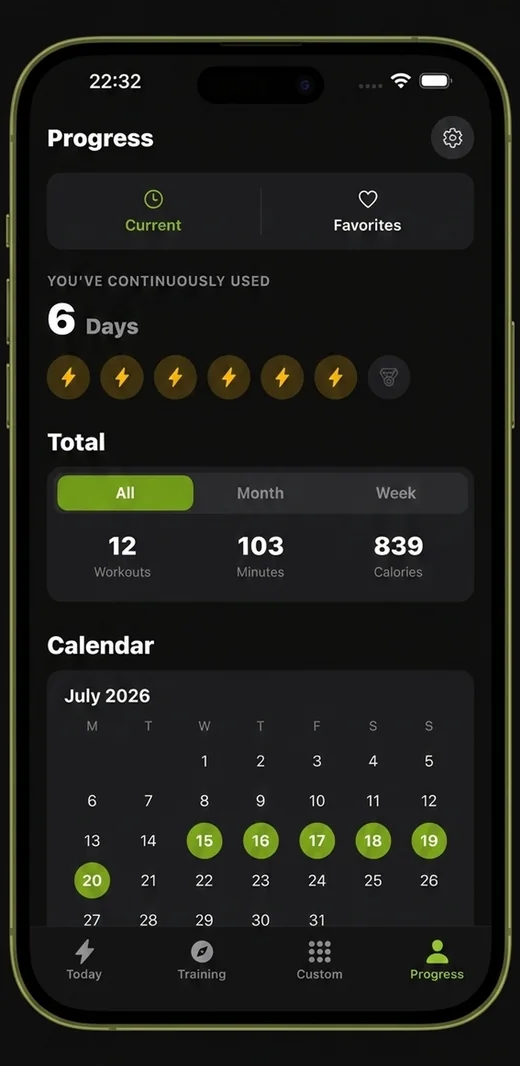
Military Calisthenics Coach is a 21-day military-style calisthenics program for iPhone: one guided bodyweight workout a day, with timed sets and rests, ranks and streaks. It is a separate program from the guides on this site.
- A 21-day military-style program, one workout a day
- Guided timed sessions — no counting, no guessing
- Build your own sessions by time, body zone or focus



A shrimp squat is a one-leg squat in which you hold your rear foot behind you with the same-side hand and lower until your back knee touches the floor just behind your standing heel, then stand back up on one leg. It trains the quads of the standing leg through a very deep bend, plus balance and ankle range. Start at the easier stage you can do cleanly with 3 sets of 3 to 5 reps per leg, and build to 3 sets of 5 full shrimp squats per leg before you add weight.
This guide covers what it trains, how to do it, which hand to use, what 25 published guides recommend and where they disagree, how it compares with the pistol squat, a readiness test and a five-stage progression.
Key takeaways
- Guides disagree on what a shrimp squat even is. Of the 25 we reviewed, 9 hold the foot with the same-side hand, 1 uses the opposite hand, 1 uses both hands, 6 hold it without saying which hand, and 8 do not hold the foot at all in the main version.
- Only 9 of the 25 guides give a rep range for the shrimp squat, and only 4 give any number to reach before moving on (two of those are not shrimp squat rep targets: one is for split squats, one is mostly hold times). The progression below gives a target for every stage.
- The pistol comparison is split. Leaving out the three guides that describe a different exercise, 5 of 22 rank the pistol as harder, 2 rank the shrimp squat as harder, 4 say it depends and 11 do not compare.
- We found no study that tested the shrimp squat. PubMed reports the phrase as not found, and none of the six studies cited by three guides tested it. The closest, a one-leg squat with the free leg behind, found less glute activity while lowering than with the free leg in front.
- Holding a support is by far the most common easier version (20 of 25 guides). Putting something under the back knee to shorten the range (8 of 25) is the easiest one to track week to week.
What the shrimp squat trains
| Body part | What it does in the movement |
|---|---|
| Quads (standing leg) | Straighten the knee from a very deep bend; the main work |
| Glutes (standing leg) | Straighten the hip as you stand and keep the knee in line over the foot |
| Ankle and calf (standing leg) | Let the shin travel forward with the heel still down |
| Front of thigh and hip (rear leg) | Get stretched, because the rear knee is bent and the hip is behind you |
| Trunk muscles | Keep your chest up and stop you tipping forward or back |
This table comes from the joint positions, not from lab measurements. We found no study that measured muscle activity in the shrimp squat (see what the research shows).
How to do a shrimp squat
- Stand on one leg. Put a thin pad, folded towel or yoga mat on the floor just behind your standing heel.
- Hold the rear foot. Bend your free leg behind you and hold the top of the foot or ankle with the same-side hand, like a standing quad stretch. Keep the two knees close together.
- Reach forward. Hold your free arm straight out in front at shoulder height. It moves your weight forward so you do not tip backward.
- Lower under control. Bend the standing knee and hip together. Let the knee travel forward over the toes and your chest lean forward. Keep the standing heel flat. Take about three seconds.
- Touch the knee down. Lower until the back knee lightly touches the pad, just behind the standing heel. Do not rest your weight on it.
- Stand up by pushing through the whole standing foot, still holding the rear foot. That is one rep. Do all reps on one leg, then switch.
Should the standing knee go past the toes? Yes. There is no way to get the back knee to the floor without it. In a study of barbell squats, blocking the knees from moving forward cut average knee torque from about 150 to about 117 N·m but raised average hip torque from about 28 to about 303 N·m, and made the trunk lean further forward (Fry 2003). That was a two-leg barbell squat in seven men, not a shrimp squat, but it is why you should not try to hold the shin vertical.
Which hand holds the foot?
Use the same-side hand: right hand holds the right foot. Nine of the 11 guides we reviewed that name a hand use the same side. One (Kensui) uses the opposite hand, and one (Inspire US) holds the foot with both hands.
In our view the same-side grip is also the easiest to balance: it leaves the other arm free to reach forward as a counterweight, and you do not have to reach across behind your back, as the opposite-hand grip requires. Holding with both hands takes away the counterweight, so it is a harder version, not the standard one (stage 5 below).
Two other naming problems show up in the guides:
- Skater squat. Two guides (VAHVA Fitness, Fitness Volt) say the shrimp squat is “also known as” the skater squat. Two others (Lift Manual, ripped.club) use “skater squat” for the version where you do not hold the foot. In this guide, the shrimp squat always holds the foot.
- A different exercise under the same name. Three of the 25 guides describe something else: two with the free leg extended behind (one calls it a barbell back squat variation), and one with the free leg held out in front like a pistol squat.
What 25 shrimp squat guides recommend
We collected 25 English-language shrimp squat guides from Google’s US results and related searches on 9 November 2026 and coded what each one tells readers to do. Page one of Google for “shrimp squat” was mostly Reddit, Facebook and YouTube results, with two written guides (The Movement Athlete and MasterClass), so most guides came from deeper results and related searches.
| What we checked | Guides (of 25) |
|---|---|
| Hold the rear foot with the same-side hand | 9 |
| Hold the rear foot with the opposite hand | 1 |
| Hold the rear foot with both hands | 1 |
| Hold the rear foot, hand not stated | 6 |
| Do not hold the rear foot in the main version | 8 |
| Back knee touches the floor at the bottom | 14 |
| Give a rep range for the shrimp squat | 9 |
| Give a number you must reach before moving on | 4 |
| Easier version: hold a support (wall, rack, chair, straps) | 20 |
| Easier version: arms or a weight forward as a counterweight | 9 |
| Easier version: something under the back knee to shorten the range | 8 |
| Easier version: go less deep, without an object | 6 |
| Easier version: lunge or split squat first | 5 |
| Harder version: add weight | 16 |
| Harder version: stand on a box or plate to go deeper | 10 |
| Warn about knee pain or strain | 11 |
| Cite any research | 3 |
| Cite research that tested the shrimp squat | 0 |
Three things stand out:
- Rep advice is thin. Only 9 guides give a rep range. They run from 3 to 15 reps, and 7 of the 9 ranges include 5. Only 5 say the reps are per leg.
- Almost nobody says when to move on. Four guides give a number: Progresspedia (3 × 10 per leg with the knee touching), Genghis Fitness (5 clean reps per leg before adding difficulty), The Movement Athlete (hold times and rep targets in a progression table) and Inspire US (3 × 15 to 20 split squats before starting the shrimp progression).
- Support is the default fix. Twenty guides say to hold something. Only eight give a way to shorten the range with an object under the back knee, which lets you train the hardest part, standing up from the very bottom, at a height you control.
How we got this. We took 32 guide URLs from the Google US results for “shrimp squat” and “shrimp squat progression” (via DataForSEO) and nine related web searches, excluding video and social posts. Five pages could not be fetched (three blocked our script, including MasterClass; one domain did not resolve; one did not respond) and two were dropped (a page about a different variation and a general leg article), leaving 25. Each page’s full text was coded against a fixed codebook, with the hard calls re-read and documented. One example: Kensui’s easier version puts “[an] elevated surface on the side of your non-working foot” to shorten the range, which we counted as an object under the back knee; without it that count would be 7. The data covers one day of search results; guides change, and coding free text involves some judgment. With 25 pages, read these as counts, not percentages of all guides.
Shrimp squat vs pistol squat
Both are full one-leg squats, and the guides do not agree on which is harder. This count leaves out the three guides that describe a different exercise (see above):
| Verdict | Guides (of 22) |
|---|---|
| Pistol squat is harder | 5 |
| Shrimp squat is harder | 2 |
| Depends on the person, no ranking | 4 |
| No comparison | 11 |
They limit you in different places:
| Shrimp squat | Pistol squat | |
|---|---|---|
| Free leg | Bent behind you, foot held | Straight out in front, held off the floor |
| Bottom position | Back knee touches the floor behind the heel | Hips down to the heel, free leg still up |
| Common limit | Standing up from the knee-down position; tight front of the thigh on the rear leg | Holding the free leg up; ankle range; falling backward |
| Counterweight | One free arm reaching forward | Both arms and the free leg in front |
Which to train first. The pistol squat. The knee-dominant ladder in our leg workout puts the full pistol squat at rung 6 and the shrimp squat at rung 7, both at 3 × 5 per leg (the same target as stage 4 below), and you take the rungs in order.
What the research shows
We searched PubMed for “shrimp squat” and “shrimp squats” on 9 November 2026. PubMed reported both phrases as not found. Its fallback search returned 15 crustacean and aquatic-ecology records. Three of the 25 guides cite research, six studies in total, and none of those studies tested the shrimp squat. Inspire US cites barbell squat studies, and one link in Genghis Fitness points to a paper on brain cell receptors.
The closest study, cited by Calisthenics.com, is Khuu 2022. Seventeen healthy adults did one-leg squats “as low as possible” with the free leg in three positions and their arms at or out to their sides, not reaching forward as in a shrimp squat. In the version closest to a shrimp squat, the free knee was bent to 90° with the thigh kept vertical. While lowering, the glutes of the standing leg were less active with the free leg behind than with it in front. That is not a shrimp squat (the back knee did not go to the floor), but it suggests the leg-behind position shifts some work away from the glutes.
So treat any exact muscle-activation percentage for the shrimp squat with suspicion; we could not find a source for one. Nothing has tested whether it is safer or riskier for knees than other squats either. One guide (Community Strength Austin) says it “might be gentler” on the knees than the pistol because it involves “less forward knee travel”. That is an opinion, not a finding, and the back knee cannot reach the floor without the standing knee moving well forward (see the form section).
Find your starting stage
After a warm-up, test in this order and stop at the first step you cannot pass:
- Reverse lunges. Do 10 per leg, stepping back until the back knee lightly touches a pad. Cannot do all of them with control: start at stage 1.
- Supported shrimp squat. Holding a door frame with one hand and your rear foot with the other, do 5 reps per leg with the back knee touching the pad. You pass if your door-frame hand only steadies you. If you have to pull on it to stand up: start at stage 2.
- Free shrimp squat. Do 5 reps per leg with the free arm forward and no support. If you fall, drop onto the knee or cannot stand back up: start at stage 3. If all 5 reps per leg are clean: start at stage 4.
Test both legs and start at the stage of your weaker leg. The test uses single sets so it fits in one session, which means it can place you above a stage whose 3-set target you have never hit. That is deliberate: the test checks whether you can already do each movement cleanly, and the 3-set targets then build volume at the right stage. If you cannot manage 3 sets of 3 at your starting stage in the first week, drop back one stage.
The 5-stage shrimp squat progression
Train it two or three times a week. Do 3 sets per leg with 60 to 90 seconds of rest. Start each new stage at 3 sets of 3 to 5 reps per leg and add one rep per set when every rep is clean, until you reach the target. Move up when you hit the target for all three sets on both legs with clean reps: standing heel flat, knee in line with the toes, three seconds down, and the back knee touching the pad without resting on it.
| Stage | Exercise | Move up when |
|---|---|---|
| 1 | Reverse lunge, knee to a pad | 3 × 10 per leg |
| 2 | Supported shrimp squat | 3 × 8 per leg with light hand support |
| 3 | Shrimp squat to a raised target | 3 × 8 per leg with the stack one layer above the pad |
| 4 | Full shrimp squat | 3 × 5 per leg |
| 5 | Harder shrimp squat (weighted, deficit or two hands on the foot) | Add difficulty again at 3 × 8 per leg |
These targets are our own coaching rules, set so each stage builds what the next one needs. No study has tested them.
Stage 1: Reverse lunge, knee to a pad. Step back with one foot and lower until the back knee lightly touches the pad, keeping most of your weight on the front leg. Push back up through the front foot. It teaches the knee-down bottom position with two feet on the floor. If you already do Bulgarian split squats for 3 × 12 per leg, skip this stage.
Stage 2: Supported shrimp squat. Do the full shrimp squat while one hand holds a door frame, post or sturdy railing and the other holds your rear foot. Use the support only as much as you need, and hold more lightly each week until your hand only steadies you.
Stage 3: Shrimp squat to a raised target. Stack folded mats, cushions or books behind your standing heel so the back knee touches down a few inches above the floor. Free arm forward, no support. When you hit 3 × 8 per leg at one height, take a layer away. Move up once you hit 3 × 8 per leg with a single layer left on top of the thin pad. Expect to spend the longest here; the stack height makes progress easy to track.
Stage 4: Full shrimp squat. No support, back knee to the thin pad. Three seconds down, stand up without bouncing off the knee. Move up at 3 × 5 per leg.
Stage 5: Harder shrimp squats. Pick one way to make it harder at a time:
- Weighted: hold a light dumbbell or a backpack in the forward hand. Our weighted calisthenics guide covers home options.
- Deficit: stand on a sturdy step or plate so the back knee can go below the level of your standing foot.
- Two hands on the foot: hold the rear foot with both hands behind you. You lose the arm counterweight, so balance gets much harder.
Common mistakes and how to fix them
| What you notice | What is happening | Fix |
|---|---|---|
| You drop the last few inches onto the knee | Not enough strength at the very bottom | Go back to a raised target (stage 3) at a height you can control |
| You fall backward | Weight is behind your foot | Reach the free arm further forward; let the chest lean forward |
| Standing heel lifts | Ankle range runs out | Raise the knee target, or put a thin plate under the heel for now |
| Knee caves in over the arch | Hip muscles losing control | Push the knee out over the middle toes; slow down |
| You lose the grip on the rear foot | Tight front of the thigh on the rear leg | Hold the ankle or sock instead of the toes, or loop a strap around the foot |
| You bounce up off the back knee | Using the knee as a springboard | Touch, pause for a moment with no weight on it, then stand |
| Knee pain in the standing leg | Too much too soon | Drop a stage. If it keeps hurting, stop and get it checked |
Where it fits in a workout
As a main leg exercise. Put it first in a leg session, when you are fresh, and pair it with a hamstring exercise such as the Nordic hamstring curl. Three sets per leg is enough.
Alongside other one-leg work. It goes well with the Cossack squat, which trains deep side-to-side range, and the Bulgarian split squat, which builds strength at a less extreme depth. Do not stack all three heavy in one session.
On a full leg plan. Our calisthenics leg workout shows how the knee-dominant ladder, hamstring work and calves fit together across a week.
Frequently asked questions
What muscles do shrimp squats work?
The standing leg does the work: mainly the quads, which straighten the knee from a very deep bend, with the glutes helping at the hip. The ankle of the standing leg has to bend a long way, and the rear leg gets a stretch across the front of the thigh and hip. We found no study that measured muscle activity in the shrimp squat itself.
Which hand do you hold your foot with in a shrimp squat?
The same-side hand: right hand holds the right foot. Nine of the 11 guides we reviewed that name a hand use the same side. It also balances better: the free arm can reach forward as a counterweight, and you do not have to reach across behind your back.
Is the shrimp squat harder than the pistol squat?
The guides do not agree. Leaving out the three that describe a different exercise, 5 of the remaining 22 rank the pistol as harder, 2 rank the shrimp squat as harder, 4 say it depends on the person and 11 do not compare them. The leg ladder on this site puts the full pistol squat first and the shrimp squat after it, so train them in that order.
How many reps of shrimp squats should I do?
Start each stage with 3 sets of 3 to 5 per leg, two or three times a week, and add a rep per set when every rep is clean. Only 9 of the 25 guides we reviewed give a rep range, and 7 of those 9 ranges include 5 reps. Build to 3 sets of 5 full shrimp squats per leg before adding weight or depth.
Are shrimp squats bad for your knees?
No study has tested the shrimp squat, so nobody can say it is good or bad for knees. It does bend the standing knee very deeply under your full body weight, and 11 of the 25 guides we reviewed warn about knee pain. Build up through the easier stages, use a pad under the back knee, and stop if the knee hurts.
Should your back knee touch the floor in a shrimp squat?
Yes, lightly. Fourteen of the 25 guides we reviewed say the back knee touches the floor at the bottom, and three stop just above it. Touch it to a thin pad without resting your weight on it, then stand up.
Where to start
Take the readiness test, start at the stage it gives you and train it two or three times a week. Expect to spend the longest at stage 3, lowering the knee target a layer at a time. Once you reach 3 × 5 full shrimp squats per leg, the rest of the calisthenics leg workout shows where it fits in a full week.
Sources
- Khuu A, Loverro KL, Lewis CL. Muscle activation during single-legged squat is affected by position of the nonstance limb. Journal of Athletic Training, 2022.
- Fry AC, Smith JC, Schilling BK. Effect of knee position on hip and knee torques during the barbell squat. Journal of Strength and Conditioning Research, 2003.
- PubMed search for “shrimp squat” OR “shrimp squats”, run 9 November 2026: PubMed reported both phrases as not found.
- Guide survey data: 25 shrimp squat guides collected 9 November 2026, coded by bestcalisthenicsworkout.com.
- Guides referenced by name: Kensui, Inspire US, VAHVA Fitness, Fitness Volt, Lift Manual, ripped.club, Progresspedia, Genghis Fitness, The Movement Athlete, Community Strength Austin, Calisthenics.com.