Calisthenics for Weight Loss
What bodyweight training does and does not do for fat loss, and how to train while eating less without losing the muscle you built.
On iPhone

Military Calisthenics Coach
Take the drill with you
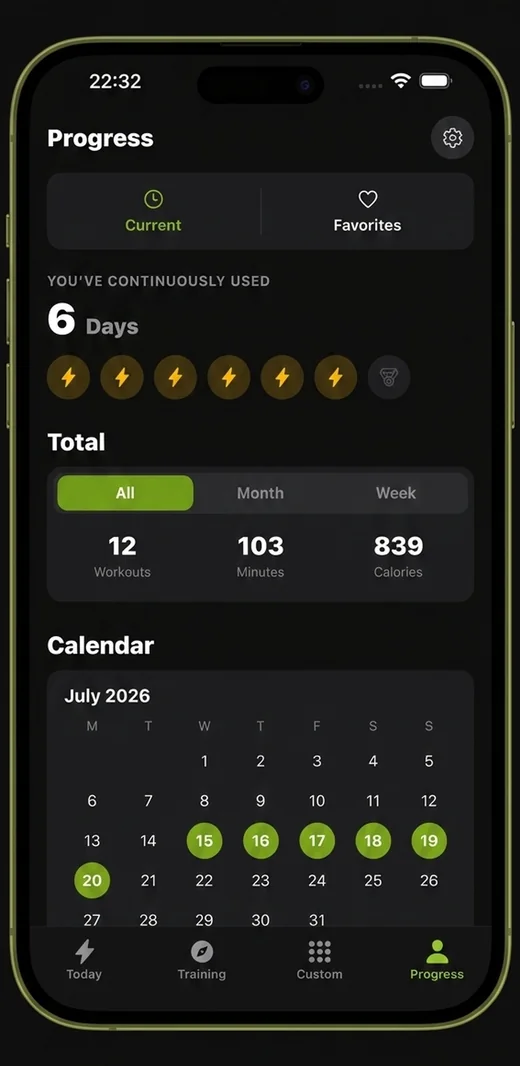
Everything on this site, built into a pocket coach. Military Calisthenics Coach turns the standards into a daily session you can run in a barracks, a garage or a hotel room — timed, tracked and scaled to you.
- A 21-day program that adapts to your level
- Guided timed sessions — no counting, no guessing
- Ranks, streaks and progress you can actually see



Training does not make you lose fat. A sustained energy deficit does. What training decides is what the weight you lose is made of — and that difference is the entire reason to keep lifting your own bodyweight while you eat less.
Someone who loses ten kilos on a diet alone typically loses two or three of them as muscle. Someone doing the same diet with three strength sessions a week keeps nearly all of it. Same number on the scale, completely different outcome.
Where the deficit comes from
The arithmetic is unglamorous. A 35-minute bodyweight session burns somewhere between 200 and 400 calories depending on your weight and how long you rest. That is a large coffee and a pastry. Meanwhile, a moderate deficit of 400 to 500 calories a day produces roughly half a kilo of fat loss a week — sustainably, and without the strength collapse that steeper deficits produce.
So the food does the fat loss. The training protects the muscle. Treat them as two different jobs and both get easier to manage.
What to train
Exactly what you would train otherwise. Do not switch to high-rep circuits because you are cutting.
This is the most common mistake in the whole topic. People in a deficit drop the hard sets, do thirty-rep circuits “for fat burning”, and lose the very stimulus that tells the body to keep its muscle. Keep the best calisthenics workout as it is: six movements, hard sets, three times a week.
What you may need to reduce is total volume. In a deficit, recovery is slower. If you were doing four sets, three is often plenty; if sessions start leaving you flat for two days, cut a set rather than a session.
Add walking, not intervals
Walking is the most useful cardio in a fat-loss phase, because it adds energy expenditure at almost no recovery cost. Eight to ten thousand steps a day is a meaningful amount of energy over a week and it will not interfere with Wednesday’s pull-ups.
High-intensity intervals burn more per minute and cost far more to recover from. Stacked on top of a deficit and three strength sessions, they are usually the thing that tips people into the under-recovered state described in the recovery guide.
Protein matters more in a deficit
When energy is short, the body is more willing to break down muscle for fuel. Protein is the main defence: roughly 1.6 to 2.2 grams per kilogram of bodyweight per day, spread across the day rather than in one meal.
For an 80 kg person that is 130 to 175 grams. It is more than most people eat by default and it is the single highest-leverage dietary change in this whole article.
A useful side effect
Every kilogram you are not carrying is a kilogram you do not have to lift. The relationship is most obvious on pull-ups: people who lose weight while training the pull-up progression often get their first rep during the cut, having failed at it for months at a heavier weight.
The same applies to dips, pistol squats and every skill in the sport. Relative strength is the currency of calisthenics, and the denominator counts.
What progress looks like
The scale is noisy. Water, food volume and sodium move it by a kilo or two in a day, which tells you nothing about fat.
Better signals, checked weekly:
- The average of seven daily weigh-ins, not any single one.
- Reps on the same variation of the same movement, from your training log.
- How clothes fit, which lags the scale but is more honest.
If the weekly average is falling and your reps are holding steady, the plan is working exactly as intended. If reps start falling across two consecutive weeks, the deficit is too steep — eat a little more and slow down. Losing fat over six months and keeping it off beats losing it over six weeks and rebuilding the same body twice.